
🌿 EMDR & Ketamine-Assisted Psychotherapy: Real Options for Trauma Healing
April is Sexual Assault Awareness Month, and as conversations about trauma deepen in our culture, we want to meet that moment with something practical and powerful: real information about the most effective trauma treatment options available today — and the intensive formats that can accelerate healing in ways that traditional weekly therapy sometimes cannot.
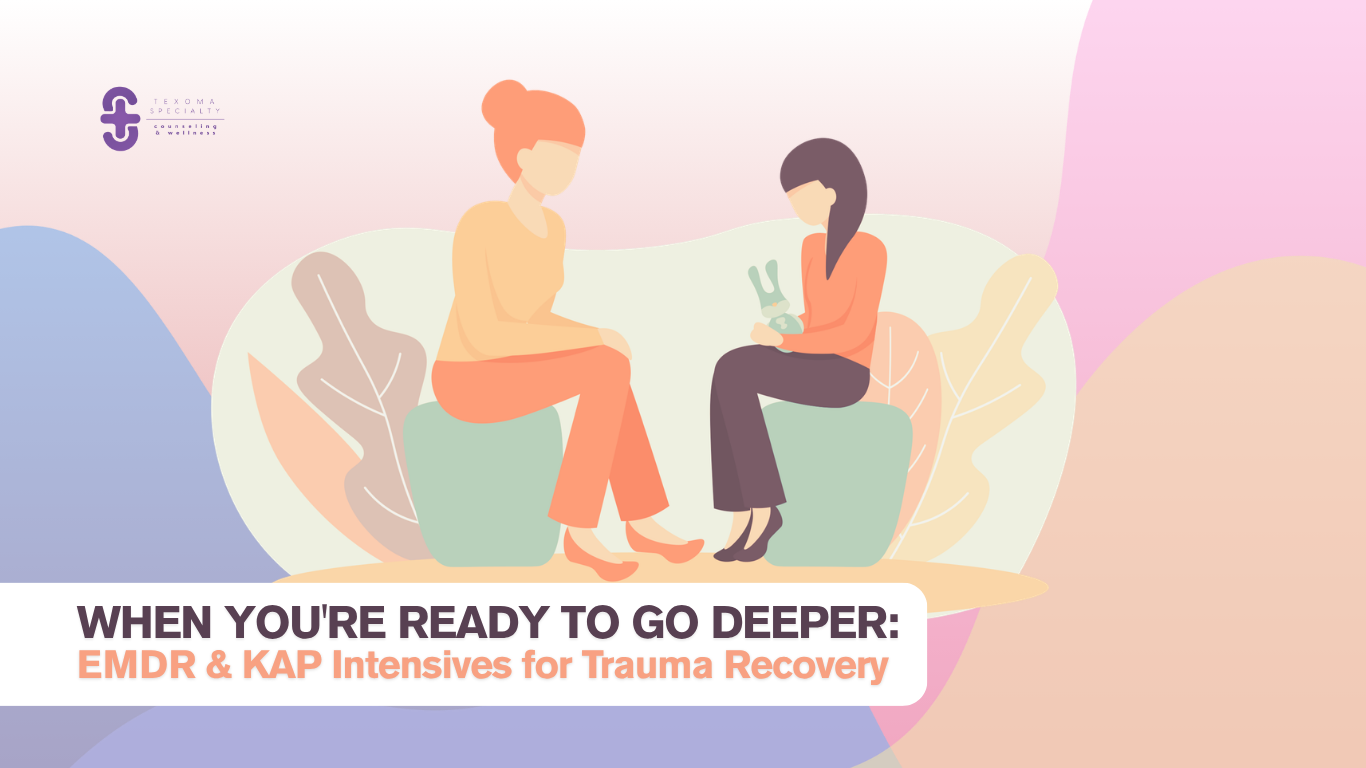
At Texoma Specialty Counseling & Wellness, we offer two of the most clinically effective, evidence-based trauma treatments available: EMDR (Eye Movement Desensitization and Reprocessing) and Ketamine-Assisted Psychotherapy (KAP). Both are available in traditional weekly formats — and both are offered as intensive programs for those who are ready to go deeper, faster, and with more sustained focus.
This blog is for anyone who has been in therapy and still feels stuck. For anyone who wants to understand their options. For anyone who is ready — or almost ready — to take the next step toward healing.
🧠 Understanding Trauma: Why Standard Weekly Therapy Isn't Always Enough
Trauma isn't just a memory — it's a physiological experience stored in the nervous system, the body, and the brain. For many survivors, especially those with complex or repeated trauma, standard 50-minute weekly therapy sessions can feel helpful but incomplete. You make progress, but the deeper material feels out of reach. You talk about what happened, but the charge around it doesn't fully shift.
This is not a failure of therapy — or of the person in therapy. It's a reflection of how trauma actually works in the brain and body. Healing trauma requires more than insight. It requires neurological reprocessing, nervous system regulation, and often, a sustained window of focused therapeutic work.
That's exactly what EMDR and KAP intensives are designed to provide.
👁️ What is EMDR Therapy?
EMDR — Eye Movement Desensitization and Reprocessing — is a highly researched, evidence-based therapy specifically developed to help people process and heal from traumatic experiences. It works by engaging the brain's natural information processing system through bilateral stimulation (typically eye movements, tapping, or sound) while the person focuses on a traumatic memory.
Unlike traditional talk therapy, EMDR doesn't require you to describe your trauma in detail or analyze it at length. Instead, it helps the brain reprocess the memory so that it loses its emotional charge — moving it from something that feels current, threatening, and overwhelming to something that simply happened in the past.
What EMDR Can Help With:
• PTSD and complex trauma
• Sexual assault and abuse
• Childhood trauma and adverse experiences
• Anxiety and panic rooted in past experiences
• Grief and loss
• Negative core beliefs about self-worth and safety
• Phobias and performance anxiety
EMDR is endorsed by the World Health Organization, the American Psychological Association, and the Department of Veterans Affairs as one of the most effective treatments for PTSD and trauma.
Learn more about trauma & EMDR therapy at TSC.
🌸 Meet Jaclyn Contreras, LPC — TSC's EMDR Therapist
Jaclyn Contreras, LPC, completed her EMDR training in December 2022 and brings a warm, humanistic approach to trauma work. As a first and second-generation Latina therapist, Jaclyn offers a uniquely rich perspective on how culture, family systems, and identity intersect with trauma — and how healing must honor the whole person, not just the symptoms.
Jaclyn's approach draws from client-centered, existential, and emotion-focused therapy, creating a collaborative space where trauma can be processed safely at your own pace. She works with teens and adults and offers both standard EMDR sessions and EMDR intensive formats for those ready to do concentrated, immersive healing work.
📧 To work with Jaclyn: jaclyn@texomaspecialtycounseling.com
🔍 What is an EMDR Intensive?
An EMDR intensive is an extended, concentrated format of EMDR therapy — typically several hours in a single day or across consecutive days — rather than the traditional 50-minute weekly session. This format allows for deeper, uninterrupted processing that simply isn't possible in shorter sessions.
For trauma survivors, this can be a significant advantage. Trauma processing often requires momentum — the ability to go into difficult material and stay with it long enough for genuine neurological shifts to occur. Weekly sessions can sometimes mean starting that process, then stopping before it's complete, which can feel dysregulating. Intensives create the space and time to move through material more fully.
Who is an EMDR Intensive Right For?
• ✅ People who have done some therapy work and are ready to go deeper
• ✅ Those with limited availability for weekly sessions (travel, work schedules, caregiving)
• ✅ Survivors who feel "stuck" despite previous therapy
• ✅ People facing a specific upcoming challenge (court dates, anniversaries, family events)
• ✅ Those who prefer concentrated, focused healing over extended weekly work
🔬 What is Ketamine-Assisted Psychotherapy (KAP)?
Ketamine-Assisted Psychotherapy (KAP) combines the carefully administered effects of ketamine — a legal, FDA-recognized medication — with intentional, trauma-informed psychotherapy. Ketamine works by supporting the brain's neuroplasticity: its ability to form new neural connections, release old patterns, and become more open to therapeutic change.
For trauma survivors, this is powerful. Trauma creates deeply entrenched neural pathways — patterns of fear, hypervigilance, avoidance, and self-protection that the brain has learned to run automatically. KAP works at the neurological level to interrupt those patterns and create a window of openness in which real therapeutic work can take root in new ways.
Many clients describe KAP sessions as expansive, introspective, and even peaceful — a sense of distance from the usual grip of traumatic memory that allows them to process experiences with greater ease and insight than they've been able to access before.
What KAP Can Help With:
• Treatment-resistant depression and anxiety
• PTSD and complex trauma — including sexual trauma
• Eating disorders with trauma components
• Grief and chronic emotional pain
• Patterns that haven't responded to traditional therapy
• Burnout and deep emotional exhaustion
💜 Meet Dr. Stephanie Waitt, LPC-S, CEDS — TSC's KAP Provider
Dr. Steph is a licensed professional counselor supervisor, certified eating disorder specialist, and certified KAP provider through Journey Clinical. She has guided clients through ketamine-assisted therapy with a deeply compassionate, trauma-informed approach — meeting each person where they are and holding space with expertise and genuine care throughout every step of the process.
Dr. Steph offers both standard KAP sessions (individual and group) and KAP intensives — extended, immersive formats for those who want to compress significant therapeutic work into a more concentrated timeframe. Both in-person and remote options are available.
📧 To work with Dr. Steph on KAP: stephanie@texomaspecialtycounseling.com
⚡ What is a KAP Intensive?
A KAP intensive is a condensed program that includes preparation sessions, multiple dosing sessions, and integration sessions scheduled close together — often over the course of one to two weeks — rather than spread over many months. This format mirrors the approach used in clinical research and is designed to maximize the therapeutic window created by ketamine's neuroplastic effects.
The integration work — what happens between and after dosing sessions — is where much of the deepest healing occurs. In an intensive format, that integration work is supported by frequent, focused therapeutic contact rather than a single weekly check-in.
Who is a KAP Intensive Right For?
• ✅ People who have tried multiple therapies without lasting relief
• ✅ Those with treatment-resistant depression, anxiety, or PTSD
• ✅ Trauma survivors seeking accelerated healing with neurological support
• ✅ Clients who want to do deep work within a defined, focused timeframe
• ✅ Those curious about psychedelic-assisted therapy in a safe, legal, clinical setting
⚖️ Intensive vs. Traditional: Which is Right for You?
Both traditional weekly therapy and intensive formats have real value — the right choice depends on your specific history, goals, nervous system, and life circumstances. Here's a quick framework to help you think it through:
Traditional Weekly EMDR or KAP May Be Right for You If:
• You're newer to trauma work and want to build slowly and steadily
• You have a strong weekly therapy relationship you want to maintain alongside specialized treatment
• Your life circumstances require a gradual, lower-intensity approach
• You prefer more time between sessions to process and integrate
An Intensive Format May Be Right for You If:
• You're ready to go deep and want to compress your healing timeline
• You've been in therapy for a while and feel stuck or plateaued
• You have a specific event, trigger, or life transition coming up
• Your schedule doesn't allow for consistent weekly sessions
• You want maximum neurological momentum and therapeutic focus
Not sure which path is right for you? That's okay. Our team will walk you through all of it during your first conversation — no pressure, no rushing. You just have to reach out.
🌿 Healing Is Not One-Size-Fits-All — And That's the Point
At Texoma Specialty Counseling & Wellness, we believe deeply in meeting every person where they are. Trauma is complex. Recovery is nonlinear. And the most powerful thing we can do is offer you real options — evidence-based, compassionate, and tailored to your actual life.
Whether you choose weekly EMDR with Jaclyn, a KAP intensive with Dr. Steph, traditional therapy, or some combination — what matters most is that you take the first step. The rest, we figure out together.
You belong here. ♡
📅 Ready to Take the Next Step?
👉 Learn more about EMDR: texomaspecialtycounseling.com/jaclyn-contreras
👉 Learn more about KAP: texomaspecialtycounseling.com/ketamine-assisted-psychotherapy
📞 Call or text: (888) 659-7618
📧 Schedule a consultation: texomaspecialtycounseling.com/contact
📚 Further Reading
EMDR International Association (EMDRIA): Association site promoting standards and innovations in EMDR therapy and trauma-informed care.
Journey Clinical — KAP Provider Network: KAP Partner
Ketamine-Assisted Psychotherapy Research — Dore et al., 2019: KAP research on demographics and clinical data
EMDR Therapy for PTSD — American Psychological Association — APA overview of EMDR as a first-line, evidence-based treatment for PTSD.
Understanding PTSD and Trauma — National Institute of Mental Health (NIMH) — NIMH overview of PTSD, its neurological basis, and available treatment approaches.
Sexual Assault Awareness Month Resources — RAINN — RAINN's hub for Sexual Assault Awareness Month, including statistics, survivor resources, and how to get help.