
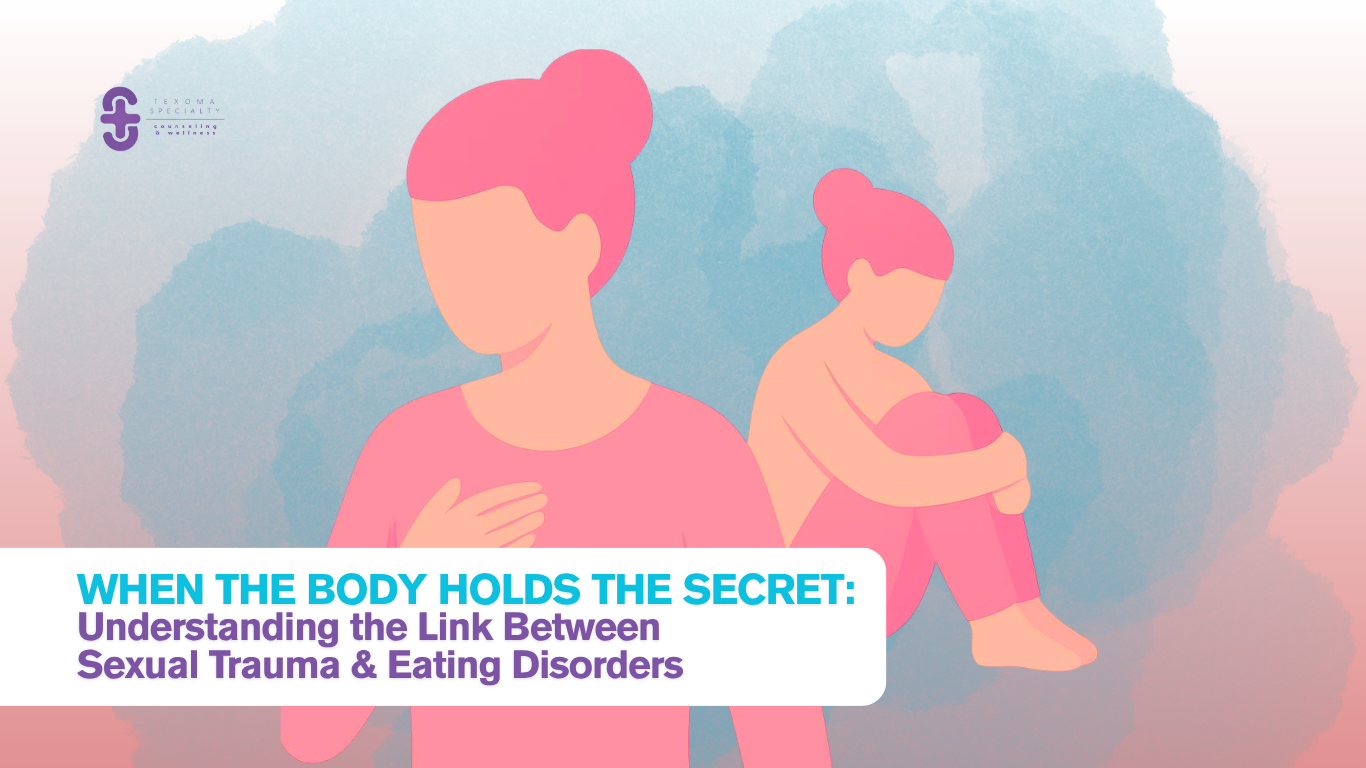
🌿 When It Was Never Really About the Food: Sexual Trauma & Eating Disorders
If you've been in eating disorder recovery for a while — or if you're just starting to look at your relationship with food and your body — you may have noticed that it's never really just about food.
For so many of the people I work with, the eating disorder didn't come out of nowhere. It came after something happened. Something that felt too big, too confusing, or too dangerous to say out loud. Something the body absorbed and held long after the mind tried to move on.
Sexual trauma and eating disorders are deeply, powerfully connected — and yet this connection is one of the most undertalked parts of both trauma recovery and eating disorder treatment. So today, let's talk about it.
You deserve to understand what's happening inside you. And you deserve care that actually gets to the root of it.
💜 The Numbers Are Hard to Ignore
Research has consistently shown that survivors of sexual trauma are at significantly higher risk for developing an eating disorder. Studies suggest that anywhere from 30–50% of people with eating disorders have a history of sexual trauma — and in clinical settings, that number is often even higher.
Some of the most commonly cited research points to:
• Women with a history of sexual abuse being up to 3 times more likely to develop an eating disorder
• Higher rates of bulimia, binge eating disorder, and ARFID among trauma survivors
• Earlier onset of eating disorder symptoms in those with trauma histories
• More severe and longer-lasting eating disorder courses when trauma goes unaddressed
These aren't just statistics. They're real people — maybe people who look a lot like you — trying to survive something that was never their fault.
🧠 Why Does Trauma Show Up in Eating Behaviors?
This is the question I get most often, and it's such an important one. The answer lives in how trauma actually works in the body and nervous system.
When something traumatic happens — especially something like sexual violation, where the boundary of your own body was crossed without your consent — your nervous system doesn't just file it away neatly. It stores it. In muscle tension, in shame, in hypervigilance, in the way you move through the world and inhabit your own skin.
The body becomes a site of danger. And eating behaviors become a way to manage that.
Here's what that can look like:
🔹 Restriction as control. When something was done to your body without your permission, controlling what goes into it — or doesn't — can feel like the only power you have left. Restriction can create a sense of predictability and safety in a world that no longer feels safe.
🔹 Bingeing as numbing. Food can serve as a powerful emotional anesthetic. When memories, flashbacks, or overwhelming feelings surface, bingeing can temporarily quiet them — creating a kind of dissociation or relief that nothing else seems to offer.
🔹 Purging as release. For some, purging becomes a way to expel not just food but emotion — shame, anger, grief, disgust. It can feel cathartic in the moment, even when it's deeply harmful.
🔹 Body manipulation as protection. Some survivors unconsciously use their eating disorder to change how their body looks — to become smaller and less visible, or sometimes larger and more formidable — as a way to feel safer from future harm.
🔹 Disconnection from the body altogether. Trauma often causes dissociation — a splitting off from physical sensation. When you've learned that your body isn't safe, it makes sense that you'd stop listening to it. Hunger cues, fullness cues, physical feelings — all of it gets muted.
None of these are character flaws. They are survival strategies. Brilliant, painful, costly survival strategies — and they made sense at the time.
🪞 The Body Image Piece
Sexual trauma doesn't just affect how people eat. It profoundly shapes how people feel about their bodies — and that's where body image and eating disorder recovery get especially complicated.
Shame is one of the most common responses to sexual trauma. Survivors frequently internalize messages that it was their fault, that their body was somehow to blame, that they are dirty, damaged, or undeserving of care. These messages embed themselves into body image in ways that go far deeper than typical societal beauty pressures.
When I work with clients at the intersection of trauma and eating disorders, I often hear things like:
"I've always hated my body. I thought that was just about food. But it started after what happened to me."
"I didn't want to be seen. I didn't want to take up space. I didn't want to be noticed."
"My body felt like it belonged to everyone else. Controlling it was the one thing that was mine."
These statements point to something important: body image work alone isn't enough when trauma is the root. The story the body is carrying needs to be witnessed and processed — not just challenged cognitively.
🌀 Why Standard ED Treatment Often Falls Short
Traditional eating disorder treatment — meal plans, nutrition education, CBT — is incredibly valuable. But for survivors of sexual trauma, that treatment often hits a wall. That's because these approaches work primarily from the neck up. They address thoughts, beliefs, and behaviors; but trauma lives below the neck — in the nervous system, in body memory, in the parts of the brain that don't respond to logic or nutrition labels.
When trauma is driving the eating disorder, asking someone to just "eat normally" or "challenge the thought" can feel impossible — not because they aren't trying hard enough, but because the survival system in their brain is still running the show. The body is still in protection mode.
This is why trauma-informed, body-inclusive treatment matters so much. Real recovery requires working with the whole person — mind, body, nervous system, and story.
💙 What Healing Actually Looks Like
I want to be honest with you: healing at this intersection is not a straight line. It takes time, it takes the right support, and it takes approaches that go deeper than surface-level symptom management.
But it is absolutely possible. I've watched people do it. I've been honored to walk alongside them.
Here's what healing can include:
🌿 Trauma-informed therapy - that acknowledges the connection between what happened to you and how you relate to your body and food — without requiring you to tell your story before you're ready.
🧠 EMDR (Eye Movement Desensitization and Reprocessing) - is one of the most well-researched trauma treatments available, and it's particularly powerful for survivors of sexual trauma. EMDR works by helping the brain reprocess traumatic memories so they lose their emotional charge — without requiring you to talk through every detail. Our therapist Jaclyn Contreras is a certified EMDR therapist who works with trauma and eating disorder recovery. You can learn more about her at texomaspecialtycounseling.com/jaclyn-contreras.
🍄 Ketamine-Assisted Psychotherapy (KAP) - offers a unique pathway for people who feel stuck in their trauma and eating disorder recovery. Ketamine temporarily quiets the default mode network — the part of the brain that keeps rehearsing shame, fear, and old stories — and creates a window of genuine neurological openness. In that window, therapeutic work can land more deeply and more lastingly than traditional approaches allow. I personally guide clients through KAP, individually and in groups. Learn more at texomaspecialtycounseling.com/ketamine-assisted-psychotherapy.
🧘 Somatic and body-based approaches - including yoga, meditation, and breathwork — help rebuild the relationship with the body that trauma fractured. Our wellness classes at TSC are intentionally trauma-informed and designed to create safety, not push through it. Learn more at texomaspecialtycounseling.com/wellness-classes.
💬 Specialized eating disorder support - that meets you where you are — whether that's individual therapy, our Recovery Academy online program, or group support. Not every person with an eating disorder needs to be at the same place in their recovery journey. What matters is finding the right level of care and the right people. Explore our Recovery Academy at texomaspecialtycounseling.com/the-recovery-academy.
🤍 A Note to Anyone Who Recognizes Themselves Here
If you've been reading this and something inside you said "that's me" — I want you to know something.
You are not broken. You are not dramatic. You are not too complicated to help.
What happened to you was not your fault. The ways your mind and body learned to cope were not your fault either. They were the best options available to you at the time.
And now — if you're ready — there are better options. There is support designed specifically for people navigating exactly this intersection. You don't have to keep carrying this alone.
Recovery is possible. A different relationship with your body is possible. A life that doesn't revolve around food and fear and shame — that's possible too.
We're here when you're ready. 💜
📍 Ready to Take the Next Step?
At Texoma Specialty Counseling & Wellness, we specialize in trauma-informed eating disorder treatment — including EMDR, KAP, somatic support, and individualized therapy for survivors navigating the intersection of sexual trauma and disordered eating.
At TSC, our trauma & EMDR therapy and eating disorder therapy are built to treat this overlap together, not one at a time.
🔗 Explore our services: texomaspecialtycounseling.com/counseling-services
🔗 Meet our team: texomaspecialtycounseling.com/the-counselors
📞 Call or text us: (888) 659-7618
If you are in crisis right now, please reach out:
• RAINN National Sexual Assault Hotline: 1-800-656-HOPE (4673)
• Crisis Text Line: Text HOME to 741741
• 988 Suicide & Crisis Lifeline: Call or text 988
📚 Further Reading & Sources
Trauma and Eating Disorders — National Eating Disorders Association (NEDA) — NEDA's overview of the relationship between trauma, PTSD, and eating disorder development.
The Body Keeps the Score: Brain, Mind, and Body in the Healing of Trauma — Bessel van der Kolk, MD — Foundational resource explaining how trauma is stored in the body and why body-based treatment approaches are essential.
EMDR for PTSD and Trauma — American Psychological Association — APA summary of EMDR research and clinical recommendations for trauma treatment.