
You Are Not Alone: Understanding Sexual Assault, Breaking the Silence, and Finding Your Way to Healing
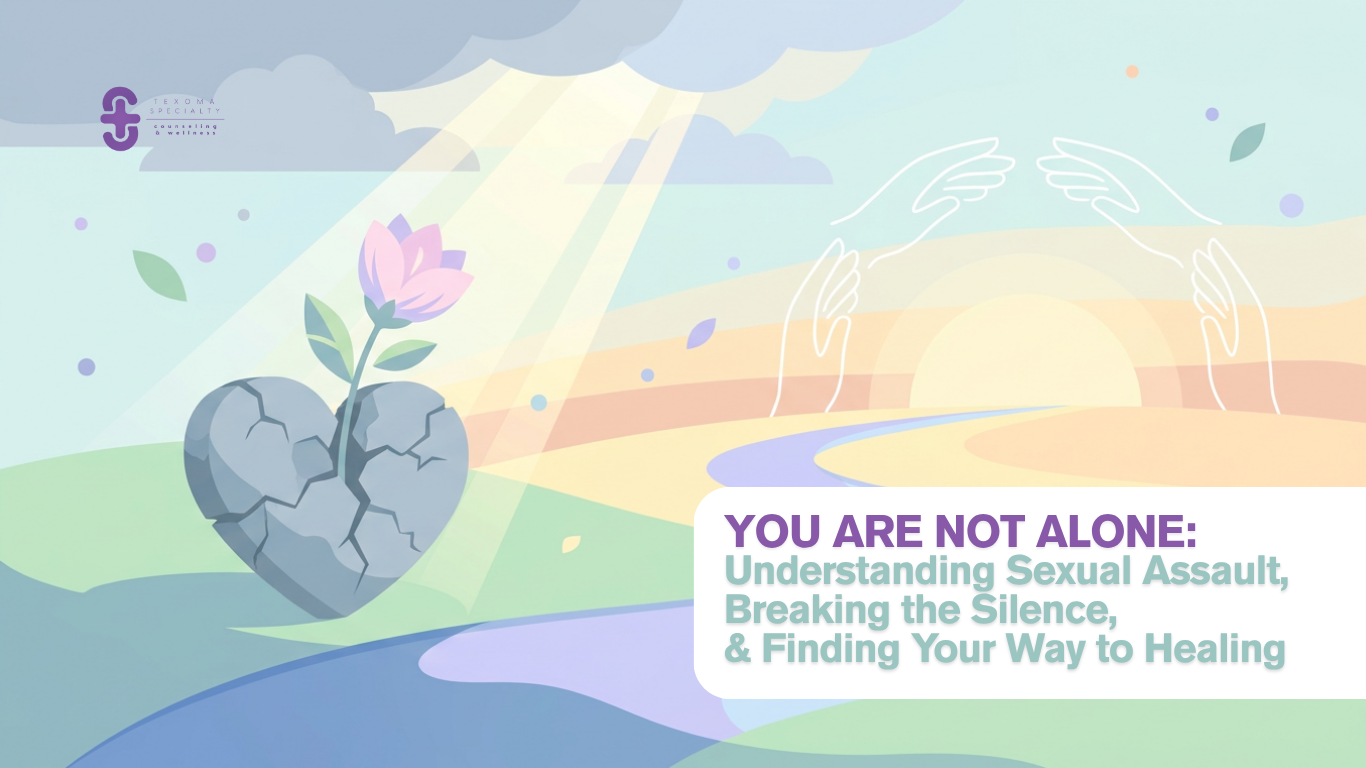
Sexual Assault Awareness Month: Facts, Silence, and Healing for Women
April is Sexual Assault Awareness Month (SAAM) — a time to acknowledge a reality that far too many women carry in silence. If you have experienced sexual trauma, we want you to know something important before you read another word: what happened to you was not your fault. You are not alone. And healing is possible.
At Texoma Specialty Counseling & Wellness, we specialize in trauma-informed care — and we meet you exactly where you are. This month, we want to hold space for an honest, compassionate conversation about sexual violence: what the numbers tell us, why so many women never get the support they deserve, what we can do together as a community, and how healing actually begins.
🔍 The Reality We Need to Talk About
Sexual violence is one of the most prevalent and least reported forms of trauma — and women bear a disproportionate burden of its impact. The statistics are sobering, but they matter because they tell us the truth:
1 in 6 women in the United States has been the victim of an attempted or completed rape in her lifetime. (RAINN)
Only 20% of college-aged women who are sexually assaulted report it to law enforcement.
Women who have experienced sexual trauma are significantly more likely to develop PTSD, depression, anxiety, and eating disorders.
In the majority of sexual assault cases, the perpetrator is someone known to the victim — a partner, family member, coworker, or friend.
These numbers represent real women — daughters, mothers, sisters, friends.
Women in our community.
Women who may be sitting in silence right now, carrying something incredibly heavy, wondering if what happened to them even "counts."
It counts. It always counts.
🚧 Why So Many Women Don't Get Help — And Why That's Not Their Fault
Survivors don't stay silent because they don't want help. They stay silent because the systems around them — and the messages they've received their whole lives — have made speaking up feel impossible, unsafe, or pointless. Here's the truth about the barriers that stand between women and healing:
Shame and Self-Blame
Culture has long placed the burden of sexual assault prevention on women — what they wore, where they went, what they drank, who they trusted. This messaging is deeply internalized. Many survivors spend years, even decades, asking themselves what they did wrong rather than recognizing they were wronged.
Fear of Not Being Believed
Women who speak out about sexual violence are routinely questioned, discredited, and dismissed — by law enforcement, by institutions, and sometimes by the very people who love them. The fear of not being believed is not irrational; for many survivors, it has been their lived experience.
Institutional Failures and Power Imbalances
When powerful individuals harm others and face few or no consequences, it sends a devastating message to survivors everywhere: that their pain is less important than someone else's status or reputation. These systemic failures erode trust in the very systems meant to protect people — and create very rational reasons why women choose silence over disclosure.
Lack of Access to Trauma-Informed Care
Even when survivors want help, they face real-world barriers: cost, lack of insurance, waitlists, rural access, and the challenge of finding a therapist who truly understands trauma. Many women have had experiences in therapy where their trauma was minimized or mishandled — which only reinforces the decision not to try again.
The Complexity of Trauma Itself
Trauma is not always immediate. Many women experience delayed reactions — numbness, minimization, or dissociation — that can make it difficult to recognize or name what happened for months or even years. The nervous system responds to threat in ways that don't always look like "classic" trauma responses, which can cause survivors to doubt their own experience.
🤝 What We Can Do — Together, as a Community
Healing doesn't happen in isolation. Community matters. Here's how each of us — whether we are survivors, allies, professionals, or community members — can contribute to a culture of safety, belief, and support:
Believe survivors. The most powerful thing you can say to someone who discloses sexual trauma is: "I believe you. I'm glad you told me. This is not your fault."
Challenge rape culture. Speak up when you hear victim-blaming language, jokes that minimize assault, or narratives that protect perpetrators over survivors.
Normalize therapy and mental health support. The more openly we talk about mental health care as a standard part of life, the less stigma survivors face in seeking it.
Support organizations doing this work. Local crisis centers, hotlines, and advocacy organizations are lifelines. Know what exists in your community and share it.
Check in on the people you love. Sometimes the most profound thing we can offer is consistent, judgment-free presence. You don't have to fix anything — just show up.
Cultural change is slow — but it begins with individual choices, repeated daily, across communities. You are part of that change.
💙 How We Support Survivors at Texoma Specialty Counseling & Wellness
We built this practice because we believe every person deserves a safe, compassionate, expert place to heal. Sexual trauma is one of our areas of deepest specialty — and we approach it with both clinical excellence and genuine human warmth.
What trauma-informed care looks like at TSC:
• EMDR Therapy (Eye Movement Desensitization and Reprocessing): A research-backed, highly effective approach for processing traumatic memories and reducing their emotional charge.
• Somatic and Body-Based Approaches: Trauma lives in the body. We use modalities that help regulate the nervous system and restore a sense of safety in your own skin.
• Individual Therapy: One-on-one sessions with compassionate, licensed counselors who understand the complexity of trauma and specialize in women's mental health.
• Ketamine-Assisted Psychotherapy (KAP): For survivors whose trauma has not responded to traditional therapy, KAP offers a powerful, evidence-informed pathway to healing that can shift deeply rooted patterns.
• Wellness Integration: Yoga, meditation, and mindfulness aren't add-ons — they're core parts of a whole-person approach to recovery. We offer wellness classes designed to help survivors reconnect with themselves at their own pace.
• A Warm, Non-Judgmental Environment: We are laid back, real, and deeply human. You will never be rushed, minimized, or made to feel like a diagnosis. You are a whole person — and we treat you that way.
🌿 A Message to Anyone Who Is Carrying This
If you are reading this and something in you quietly said "this is me" — we want you to know that reaching out is not weakness. It is one of the bravest things a person can do.
You don't have to have it all figured out before you call. You don't have to be in crisis. You don't have to know what you need. You just have to take one small step — and we will walk the rest of the path with you.
Healing is not linear. It is not fast. But it is real. And it is waiting for you.
You belong here. ♡
📅 Ready to Take the Next Step?
👉 Explore our trauma and counseling services: texomaspecialtycounseling.com/counseling-services
📞 Schedule a consultation: texomaspecialtycounseling.com/contact
📱 Call or text us: (888) 659-7618
💜 Join our email community for mental health tips and updates: NEWSLETTER
Crisis Resources
National Sexual Assault Hotline (RAINN): 1-800-656-HOPE (4673) | online.rainn.org
Crisis Text Line: Text HOME to 741741
National Domestic Violence Hotline: 1-800-799-SAFE (7233)