
School’s Out and Everyone Is Losing It (Including You) — What Play Therapy Actually Does for Kids in Summer
☀️ Kids Can Fall Apart in Summer — And What Play Therapy Can Do About It
Summer is supposed to be the good part. No alarm clocks, no homework folders, no frantic school drop-off. And yet — a lot of families hit July feeling more overwhelmed than they did in May. Kids are bored, dysregulated, and bouncing off the walls. Parents are exhausted and quietly wondering if something is wrong with their child, or with them.
Nothing is wrong. But summer is a real transition, and transitions are hard — especially for kids who thrive on routine and structure.
I’m Danielle, and I work with children and teens here at TSC. I also specialize in play therapy and sand tray therapy, and I want to tell you what that actually looks like — because most parents have no idea, and honestly? Once they find out, they wish they’d started sooner.
🧠 Why do kids fall apart in summer?
School provides a predictable container. Kids know what to expect, when to eat, when to move, when to sit still. When that structure disappears, the nervous system has to recalibrate. For some kids that looks like excitement and freedom. For others it looks like meltdowns, regression, clinginess, aggression, sleep problems, or just a general vibe of off.
That’s not bad behavior. That’s a kid who is communicating through their body because they don’t have the words yet.
🎨 That’s where play therapy comes in.
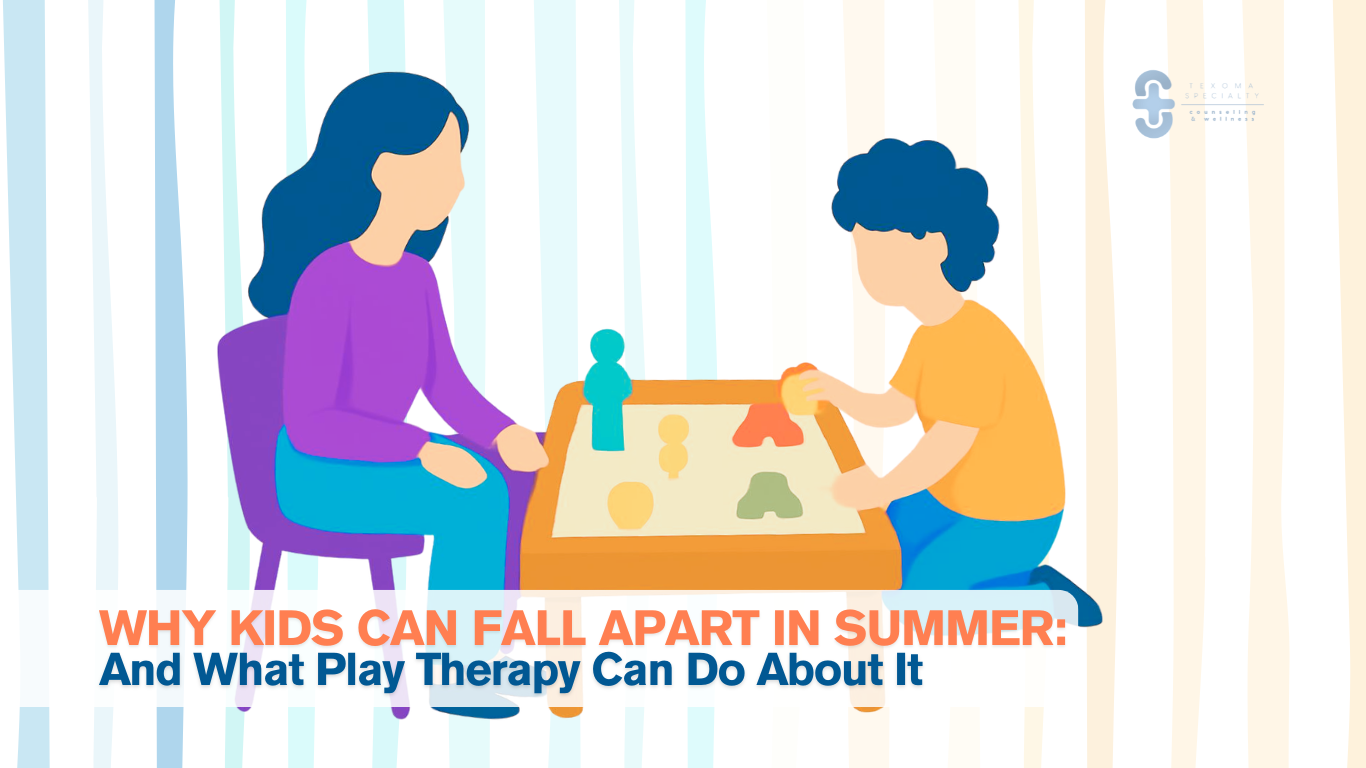
Play therapy isn’t just letting kids play while I watch. It’s a clinically grounded approach that uses play — the language kids actually speak — to help them process emotions, work through stress, and build coping skills. A child who can’t tell you “I feel anxious about starting middle school in the fall” can absolutely show you, through the way they build something in the sand tray or the story they act out with figurines.
🏜️ Sand Tray Therapy — What It Actually Looks Like
Sand tray therapy in particular is something I love. We have this tray filled with sand and hundreds of miniature figures — animals, people, buildings, nature objects — and kids (and sometimes adults too) arrange them to create scenes. What shows up in that tray is often more honest than anything they’d say out loud. And it gives us something to work with.
🔍 Signs your child might benefit from some support this summer:
⚠️ They’re having more meltdowns than usual and can’t explain why
⚠️ They seem withdrawn or anxious about the fall
⚠️ There’s been a big change in the family — a move, a divorce, a loss, a new sibling
⚠️ They’re struggling socially, or had a hard year at school
⚠️ Your gut just says something feels off
You don’t need a diagnosis. You don’t need a crisis. You just need to notice.
☀️ Why Summer Is Actually the Best Time to Start
Summer is actually a great time to start therapy with kids because the schedule is more flexible and there’s less pressure. We can build a rhythm without competing with homework and activities. And by the time school starts back up, they’ve got a few more tools in their toolbox.
If you’ve been thinking about it, this is your sign to reach out. I’d love to connect with you.
📅 Ready to Connect?
Danielle is currently accepting new child and teen clients at TSC. If you've been thinking about it, this is your sign.
📞 Call us at (888) 659-7618
👉 Learn more about Danielle
You don't have to figure this out alone — and neither does your kid. 🌿
📚 Further Reading & Sources
Why Play Therapy? — Association for Play Therapy — The professional association's overview of play therapy's evidence base, clinical applications, and why play is the natural language of childhood.
Sand Tray Therapy: An Overview — Psychology Today — Clinical overview of sand tray and sandplay therapy, including how it works and the populations it benefits most.
Early Intervention in Child Mental Health — NIMH — National Institute of Mental Health overview of child and adolescent mental health, including the research case for early identification and treatment.