
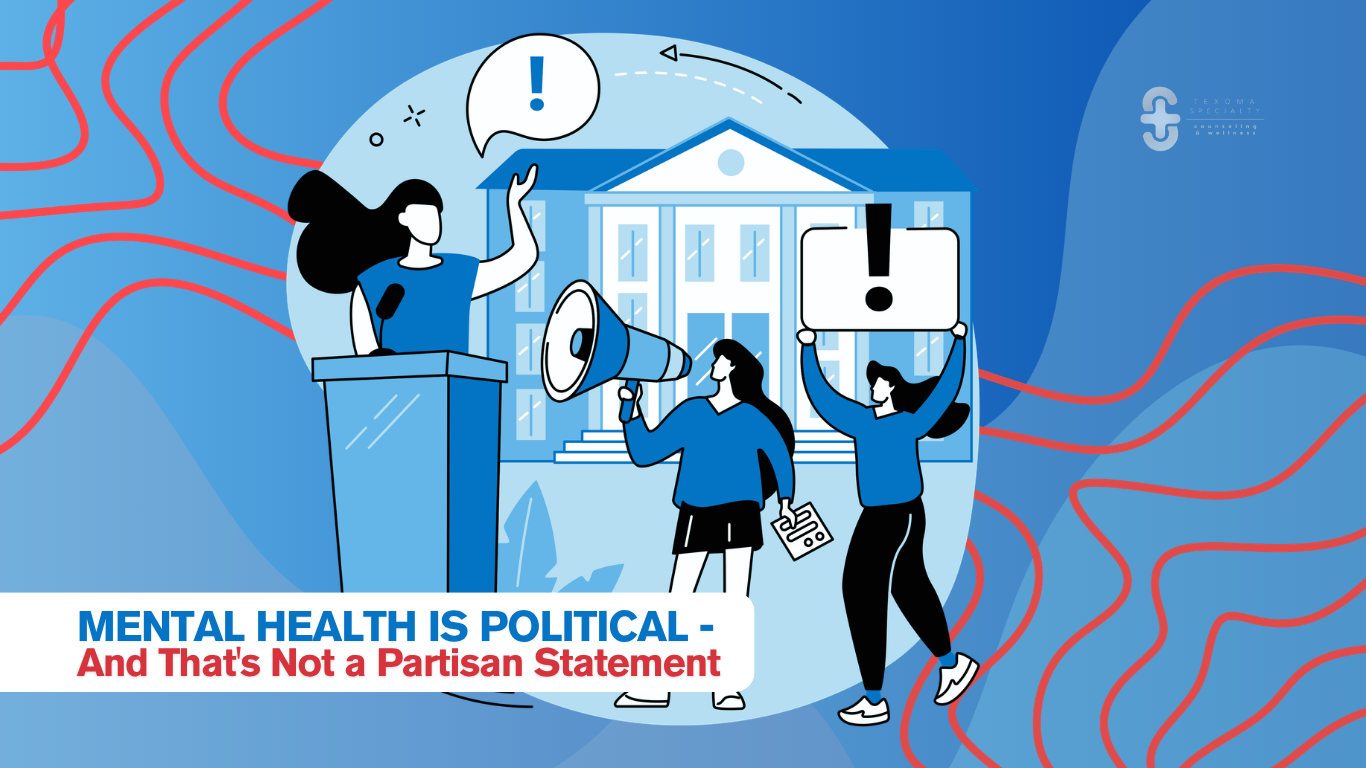
Mental Health Is Political — And That's Not a Partisan Statement
🗳️ Mental health is political
I want to talk about something that might feel a little uncomfortable at first. But stay with me — because I think by the end of this, you'll see why it matters, regardless of where you land on the political spectrum.
Mental health is political.
I know. I can already hear some of you closing the tab. But please don't — because I'm not here to talk about political parties, campaign platforms, or who you voted for. That's genuinely not what this is about. This isn't a liberal issue or a conservative issue. It's a human issue.
What I mean when I say mental health is political is this: the systems we all live inside of — healthcare, education, the economy, the workplace, our communities — have a profound and measurable impact on how people feel, cope, and function. Those systems are shaped by policy. And policy, like it or not, is political.
You don't have to agree with any particular politics to acknowledge that the world around us affects the world inside us. That's not ideology. That's just reality.
🧠 THE ENVIRONMENT SHAPES THE NERVOUS SYSTEM
Mental health doesn't develop in a vacuum. Our brains and nervous systems are exquisitely sensitive to the environments we live in — and not just the environments in our homes and relationships, but the larger structures that determine things like whether we can afford a doctor, whether we feel safe in our community, whether we have access to food, stable housing, and meaningful work.
The research on this is not subtle. Poverty, food insecurity, inadequate healthcare access, social isolation, chronic stress from financial instability — these are among the strongest predictors of mental health struggles. They don't cause moral weakness. They cause physiological changes in the stress response system. They dysregulate nervous systems. They produce the exact symptoms that bring people into therapy.
The body doesn't know the difference between a personal crisis and a structural one. Chronic stress is chronic stress — and the nervous system responds accordingly.
So when we talk about why rates of anxiety, depression, addiction, and trauma-related disorders have climbed so dramatically in recent years, we have to be willing to look beyond individual choices and genetics. The systems we participate in daily are part of the picture.
📋 SYSTEMS THAT SHAPE MENTAL HEALTH — SOME CONCRETE EXAMPLES
Let me get specific — not politically, but practically. Here are some of the systems that have a direct, documented impact on mental health, and how they do it.
🏥 Healthcare Access and Insurance
Insurance coverage determines, in very real ways, whether someone can access mental health care at all. High deductibles, narrow networks, prior authorizations, session limits — these are not just bureaucratic inconveniences. They are the difference between someone getting help and someone not getting help.
In rural communities like ours in Texoma, the challenges compound. There are fewer providers. Wait times are longer. Telehealth has helped close some of that gap, but not everyone has reliable internet access or the privacy at home to take a therapy call. When someone can't access care, they don't simply stay neutral. They get worse.
At TSC, we accept multiple insurance plans, offer sliding scale options through our team, and provide telehealth specifically because we know access is a barrier. It's one of the most concrete things we can do.
💸 Economic Stress and Financial Instability
Financial stress is one of the leading drivers of anxiety, depression, relationship conflict, and substance use. This isn't a character issue — it's a neurological one. When the brain perceives threat, it activates the stress response system. And chronic financial uncertainty is a chronic threat signal.
Wages, cost of living, access to affordable housing, job security — these economic conditions create the backdrop against which people try to hold their mental health together. A single parent working two jobs to keep the lights on is not struggling with anxiety because of a thought pattern. They're struggling because their circumstances are genuinely, objectively hard. Therapy can help them cope — but it's important we acknowledge what we're asking people to cope with.
💼 Workplace Culture and Conditions
We spend more waking hours at work than almost anywhere else. And the conditions of that work matter enormously to mental health. Burnout — now recognized by the World Health Organization as an occupational phenomenon — is driven by factors like unmanageable workload, lack of autonomy, insufficient recognition, and poor community in the workplace.
Policies around paid leave, including parental leave and mental health days, directly affect whether workers can actually rest and recover. In industries and regions where those protections are minimal, workers show higher rates of burnout, anxiety, and depression. This is especially true in caregiving professions — healthcare workers, teachers, social workers — where the emotional labor is enormous and the institutional support often isn't.
🗣️ Stigma, Community Culture, and Who Feels Safe Asking for Help
Community culture — including the values that are celebrated and the ones that are shamed — determines whether people feel safe enough to acknowledge they're struggling and reach out for support. In communities where self-reliance is a deeply held value (and I live and work in one of those communities), admitting that you need help can feel like a profound failure.
For men in particular, cultural messaging around strength and stoicism creates significant barriers to seeking mental health care. The result? More untreated depression. More substance use as a coping mechanism. More relationship breakdowns. More crisis-level presentations that could have been prevented with earlier intervention.
Stigma is shaped by culture. Culture is shaped by the stories we tell, the values we normalize, and yes — the policies and institutions that either challenge or reinforce those narratives.
🏳️🌈 Identity, Belonging, and the Cost of Marginalization
Research consistently shows that LGBTQIA+ individuals, people of color, immigrants, and other marginalized groups experience significantly higher rates of anxiety, depression, and trauma-related disorders — not because of who they are, but because of how they are treated by the systems and communities around them.
The experience of discrimination, rejection, exclusion, or simply not seeing yourself reflected in the institutions that are supposed to serve you takes a real, measurable toll on mental health. Belonging is not a luxury. It is a psychological need. And when systems fail to provide it — or actively undermine it — people suffer.
🌿 WHERE DOES THERAPY FIT INTO ALL OF THIS?
This is the part I want to be honest about.
Therapy is not a cure for systemic problems. A therapist cannot fix a broken healthcare system, eliminate financial stress, or change the culture of an entire community. And I think it's important we say that clearly — because one of the ways mental health care gets politicized is when it's positioned as the solution to problems that are actually structural.
What therapy can do — what it does every single day in our office — is help people develop the internal resources, skills, and clarity they need to navigate a world that is genuinely hard. To regulate a nervous system that has been dysregulated by circumstances beyond their control. To process experiences that have become stuck in the body. To find meaning, connection, and a sense of agency even when the external landscape is difficult.
We can't always change the water someone is swimming in. But we can help them become a stronger swimmer — and sometimes, that makes all the difference.
And sometimes — in the process of healing — people find their voice. They begin to advocate for themselves and others. They make different choices. They create ripples. That's not nothing. That's actually everything.
💜 TSC AS THE MIDDLE — WHERE EVERYONE BELONGS
A space that belongs to everyone.
I built Texoma Specialty Counseling & Wellness with a specific kind of space in mind. A space that doesn't require you to have the right politics, the right identity, the right beliefs, or the right story. A space where the only requirement is that you're human and you're hurting — or growing, or healing, or just trying to figure out how to feel better.
That means our doors are open to conservatives and progressives. To farmers and professors. To people who go to church every Sunday and people who have never set foot in one. To LGBTQIA+ individuals who have been told there's no room for them in this community, and to people who have never had to think about that kind of exclusion at all.
At TSC, the values we hold are not political values. They are human values:
• 🤍 Self-compassion over self-criticism
• 🤍 Curiosity over judgment
• 🤍 Connection over isolation
• 🤍 Healing over performing
• 🤍 Dignity for every body, every story, every person who walks through our door
We use evidence-based treatments that have been shown to work across demographics, political affiliations, and belief systems. EMDR doesn't care what you voted for. KAP doesn't ask your position on policy. The nervous system responds to safety, connection, and skilled support — full stop.
We believe that love, peace, and self-compassion are not partisan values. They are the foundation of what it means to be well. And everyone — regardless of background, belief, or circumstance — deserves access to them.
SO WHAT DO WE DO WITH ALL OF THIS?
I'm not asking you to change your politics. I'm not asking you to agree with me about any particular policy position. What I am asking — what I hope this blog does — is invite you to hold a slightly wider lens.
When someone in your community is struggling, it's worth asking not just "what's wrong with them" but "what has this person been navigating?" When mental health challenges seem widespread, it's worth asking what conditions might be contributing to that. When someone doesn't seek help, it's worth asking what barriers might be in the way.
That kind of curiosity — that wider lens — is itself a form of compassion. And compassion, I believe, is something we can all agree on.
If you're ready to take the next step toward your own mental health — regardless of what brought you here or what you believe about anything — we're here. No judgment. No agenda. Just support.
You don't have to agree with anyone to deserve care. You just have to be human. And you are. 💜
📍 Ready to Find Your Middle Ground?
At Texoma Specialty Counseling & Wellness, we serve the whole community — with trauma-informed therapy, EMDR, KAP, wellness classes, eating disorder support, and more. Everyone is welcome here.
👉 Learn about EMDR with Jaclyn