
Disordered Eating and Diet Culture in Women’s History
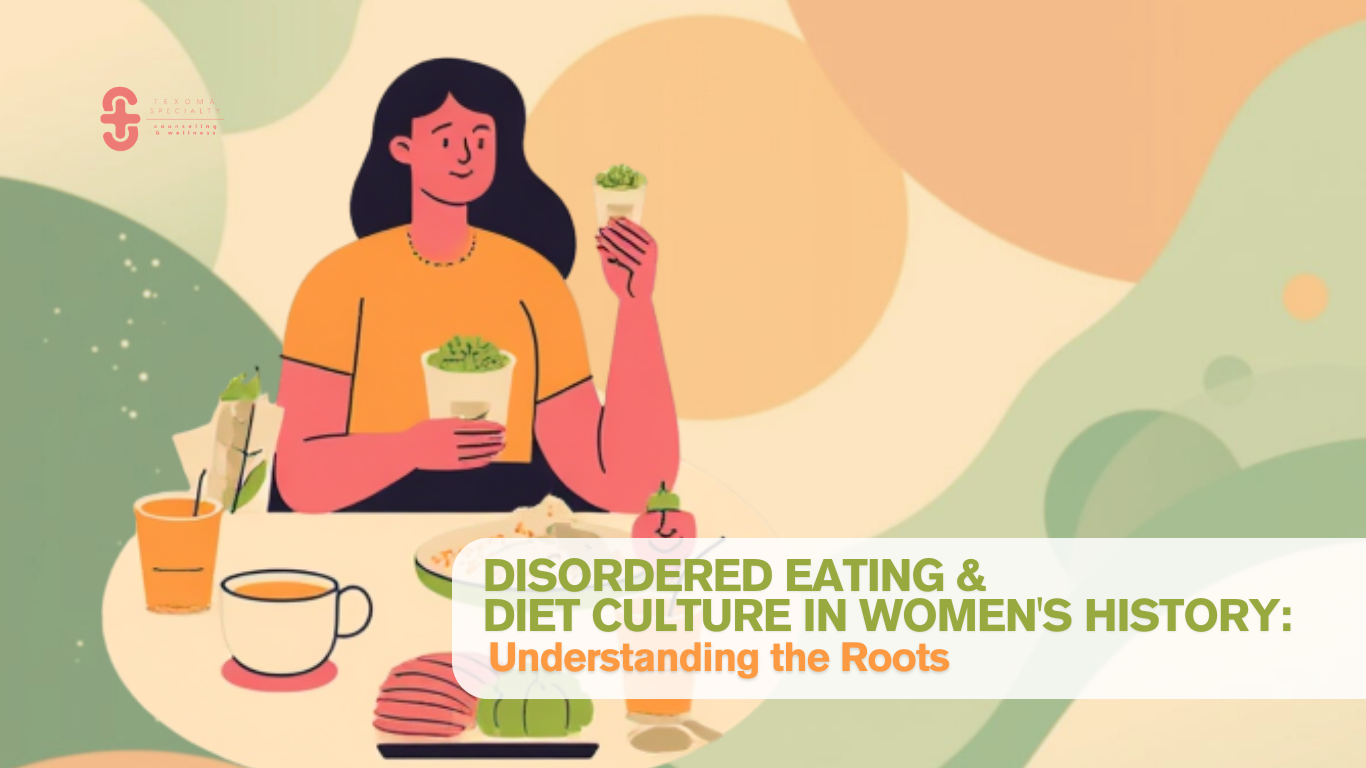
🌾 ED & Diet Culture in Women’s History: Understanding the Roots
Disordered eating does not exist in a vacuum. It has been shaped, reinforced, and normalized across generations through social expectations placed on women’s bodies, behaviors, and worth.
To understand disordered eating today, it helps to look at how diet culture evolved alongside women’s roles in history and how control over food became tied to control over identity.
🏛️ The Roots of Body Control
Historically, women’s bodies have been closely monitored and regulated as symbols of morality, discipline, and social status. In many early societies, thinness and restraint were linked to virtue, purity, and self‑control, while appetite—both literal and metaphorical—was viewed as something women should suppress. Eating “too much” or taking up “too much space” often carried moral judgment rather than neutral observation.
These beliefs laid the groundwork for disordered relationships with food by framing:
Hunger as weakness
Self-denial as strength
Body control as a path to approval, safety, or worth
These beliefs laid the groundwork for disordered relationships with food by framing hunger as weakness and self‑denial as strength. Women learned early that controlling their bodies could serve as a way to gain approval, safety, or a sense of worth in restrictive environments.
🎩 Dieting as Respectability and Status
By the late 19th and early 20th centuries, dieting became increasingly associated with social class and respectability. Thinness signaled discipline, refinement, and modernity, especially as food availability increased in industrialized nations. Women were expected to maintain slender figures as proof they were managing their households—and themselves—properly.
This era marked a shift where dieting moved from survival or scarcity into intentional restriction. Advice columns, etiquette manuals, and early health messaging promoted rigid eating rules for women, often under the guise of wellness or femininity. Food became something to manage rather than enjoy.
💬 This era marked a pivotal shift: food became something to manage rather than enjoy.
Intentional restriction replaced necessity—and the performance of eating less became a form of social currency.
📺 Post‑War Diet Culture and the Rise of “Ideal” Bodies
After World War II, diet culture expanded rapidly alongside advertising, mass media, and consumerism. Women were inundated with messages linking thinness to happiness, desirability, and success.
Magazines, advertising and television promoted:
Calorie counting and food restriction
Appetite suppressants
"Ideal" body measurements unattainable for most people
During this time, eating disorders began to be medicalized, yet the broader culture continued to reward behaviors that closely resembled disordered eating. Restriction, over‑exercise, and food obsession were normalized—especially when framed as dedication or self‑improvement.
✊ Feminism, Control, and the Body
As women gained more social and political autonomy in the mid‑to‑late 20th century, diet culture did not disappear—it adapted. Control over food and body size became one of the few socially acceptable ways for women to exert control in a culture still resistant to women’s power.
Disordered eating can be understood, in part, as a response to deeply conflicting demands placed on women:
Be independent, but compliant
Be visible, but not too visible
Be strong, but stay small
Disordered eating can be understood, in part, as a response to conflicting demands. Food and body control offered an illusion of agency within systems that limited women's autonomy. Understanding this dynamic is not about excusing harmful behaviors—it's about contextualizing where they come from.
🥗 Modern Wellness Culture and Subtle Restriction
Today, diet culture often disguises itself as wellness. Clean eating, moralized food choices, and productivity‑focused health trends continue to place pressure on women to manage their bodies perfectly. While the language has softened, the underlying message often remains the same: worth is tied to appearance, discipline, and control.
Common signs that often go unrecognized include:
⚠️ Restriction framed as "eating clean" or "being healthy"
⚠️ Fear of or guilt around specific food groups
⚠️ Chronic body dissatisfaction despite "doing everything right"
⚠️ Food rules that feel non-negotiable or anxiety-producing
When culture rewards disordered behavior, it becomes nearly invisible—even to the person experiencing it.
This makes disordered eating harder to identify, as behaviors may be socially praised rather than questioned. Restriction framed as “health,” fear of certain foods, and chronic dissatisfaction with the body are frequently normalized.
🌿 Rewriting the Narrative
Understanding disordered eating through a historical lens helps reduce shame. These patterns are not personal failures—they are learned responses shaped by generations of cultural messaging. Healing often involves not only changing behaviors around food, but also unlearning deeply ingrained beliefs about worth, control, and femininity.
Recovery challenges diet culture by reclaiming:
✅ Hunger as a valid and trustworthy signal
✅ Pleasure in eating without guilt
✅ Rest without the need to "earn" it
✅ Self-trust over external rules
It asks a different question—not "How do I control my body?" but "How do I care for myself in a way that supports my full humanity?"
🌱 Moving Forward
As conversations around body image, eating disorders, and wellness continue to evolve, acknowledging women’s history within diet culture is essential. Awareness creates space for compassion, both individually and collectively.
Disordered eating did not emerge overnight—and recovery is not about quick fixes. It is about rewriting stories that have been passed down for generations and choosing nourishment, autonomy, and respect for the body as it is.
When women are supported in trusting their bodies rather than fighting them, healing becomes not just possible — but sustainable.
📅 You Don't Have to Navigate This Alone
At Texoma Specialty Counseling & Wellness, we offer compassionate, trauma-informed support for women navigating disordered eating and body image concerns—at every stage of life.