
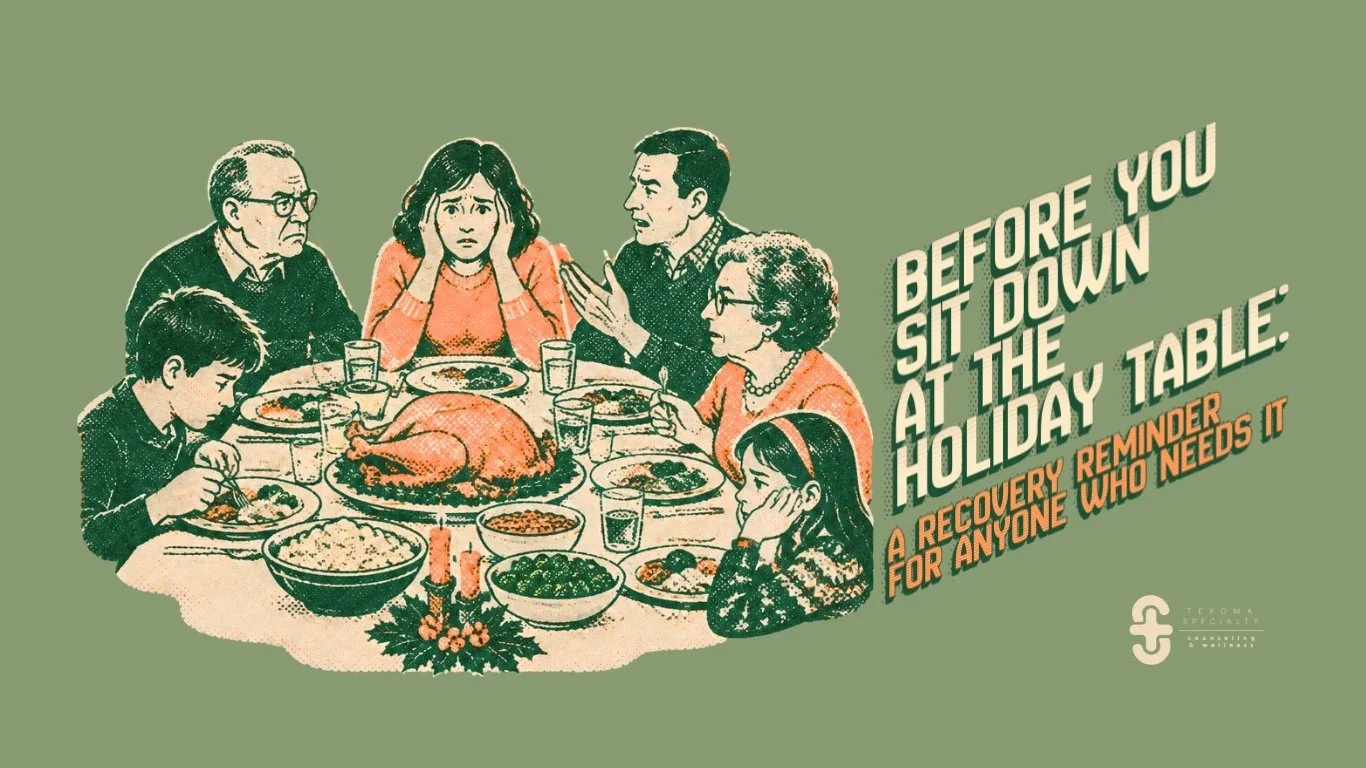
Thanksgiving is less than a week away. And if you're in eating disorder recovery — or anywhere on the spectrum of a complicated relationship with food — I want to talk to you directly before you get there.
The holiday table is one of the most loaded environments for people navigating eating disorders. It combines almost every major trigger into one room: food as the centerpiece of the event, family members who may or may not understand your recovery, comments about bodies and plates and portion sizes, the social pressure to eat in ways that look "normal," and the emotional weight of family dynamics that can make your nervous system feel anything but regulated.
It's a lot. And it makes sense that it's hard.
But I also want to offer you something more useful than a warning. I want to give you recovery reminders — things to come back to when the table gets loud.
🔍 First: understand what's actually being triggered
When the holiday meal starts to feel overwhelming, it's rarely only about the food. The food is often the surface layer. Underneath it is usually something older — fear, grief, a need for control in an environment that feels unpredictable, old wounds about belonging and worth that get activated by being back in certain family systems.
Knowing that doesn't make it easier necessarily. But it does make it make more sense. And making sense of what's happening in your body is one of the first steps toward being able to respond instead of react.
🧳 Recovery reminders for before you go
Review your plan with your therapist or support person before the event if you can. Not a rigid script — just an anchor. Who is a safe person in the room? What is your exit strategy if you need one? What is one thing you can remind yourself of if things get hard?
Eat before you go if that helps regulate you. There is nothing wrong with not arriving hungry to an event that is emotionally charged. Hunger and emotional dysregulation together is a harder combination to manage.
Decide in advance how you want to respond to comments. You don't have to have a comeback for everything. A flat "thanks" or a subject change is enough. You do not owe anyone engagement with commentary about your body or your plate.
🍽️ Recovery reminders for when you're there
Your body knows what it needs. The noise in the room does not override that information.
You are allowed to eat the food. All of it. Whatever your body is asking for. The holiday meal is not a test you pass or fail based on what ends up on your plate.
You are also allowed to not eat something. Gentle honoring of your body's signals — not restriction, not rules — is still recovery.
If a comment lands hard, you don't have to process it in the moment. You can let it sit, feel whatever you feel about it, and bring it to therapy next week. Not everything has to be handled at the table.
If you need to step away, step away. A bathroom break, a walk outside, a moment in a quiet room — regulation is not weakness. It's wisdom.
🌙 Recovery reminders for after
One meal does not define your recovery. Not a perfect one. Not a hard one. Not one where you ate more or less than you planned. Recovery is not measured meal by meal — recovery isn't a straight line.
If it was a hard day, be gentle with yourself tonight. Call someone safe. Write in your journal. Rest. Do not punish your body for surviving a hard environment.
If it was a good day — acknowledge it. Recovery wins are real and they deserve to be named.
💙 For the people at the table who love someone in recovery
Please don't comment on what they're eating or not eating. Please don't praise them for eating a lot or comment if they eat a little. Please don't bring up weight, diets, how someone looks, or what worked for you. The kindest thing you can do is talk about literally anything else and let the meal be about connection.
🆘 If this season feels like too much
Please reach out. To your therapist, to a crisis line, to the Recovery Academy. You don't have to white-knuckle your way through the holidays alone. Support exists and you deserve it.
🆘 Crisis Text Line: Text HOME to 741741 🌱 Recovery Academy: recoveryacademy.app
If you're in crisis, call or text 988 (Suicide & Crisis Lifeline) or call 911.
Learn more about eating disorder therapy at TSC, or book a session today. We're in network with Aetna, BCBS PPO, Cigna and UHC/Optum — see fees & insurance for details, or call (888) 659-7618.
We're rooting for you at every table. 💙
— Dr. Steph