

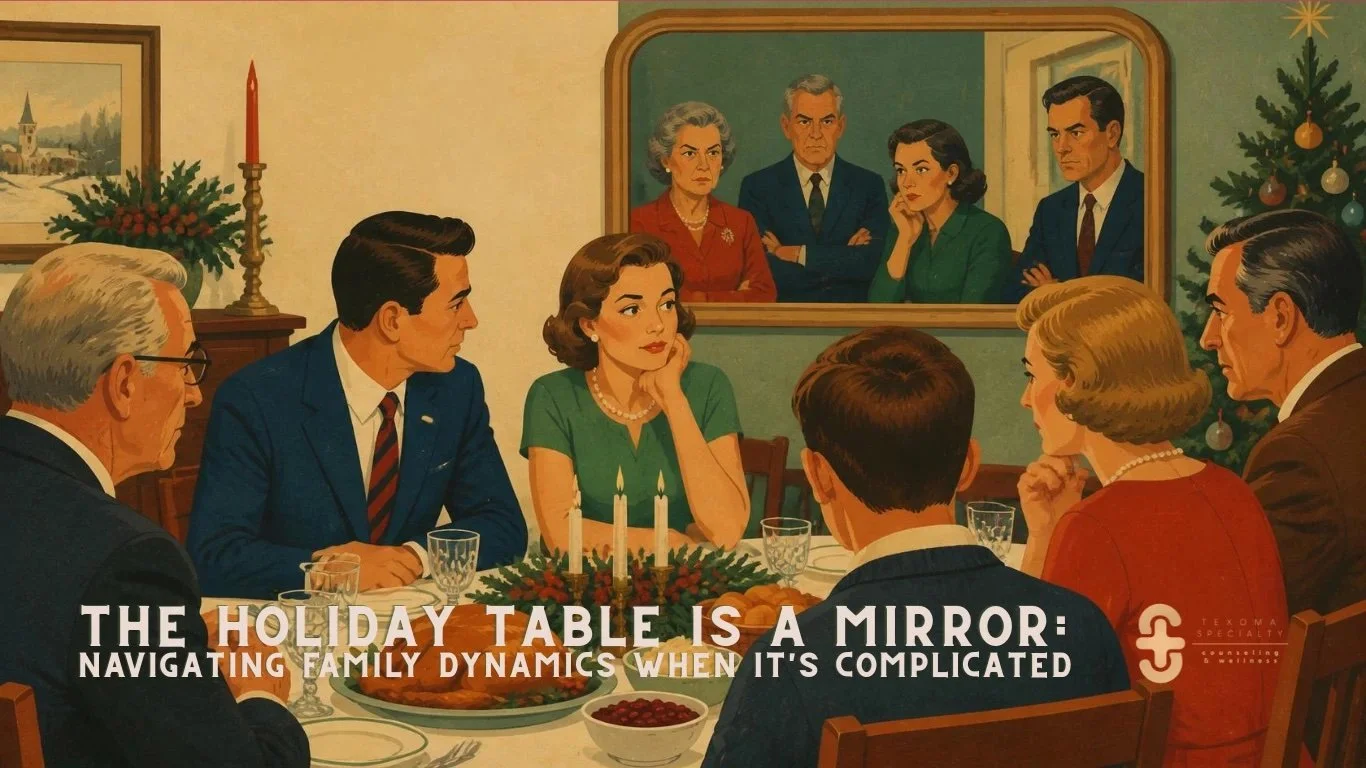
There is something about the holidays that strips away the carefully maintained distance we keep from our families the rest of the year. You spend eleven months managing the relationship from a comfortable distance — texts, occasional calls, maybe a birthday dinner — and then November arrives and suddenly you're expected to sit at the same table for hours, eat the same food, revisit the same dynamics, and call it togetherness.
For some people, that's genuinely wonderful. For a lot of people, it's one of the most stressful things they do all year. In a NAMI survey, about two-thirds of people living with a mental health condition said the holidays make it worse.
If that's you, I want you to know: you're not broken and your family isn't necessarily a disaster. Family dynamics are complicated for almost everyone. The holidays just turn up the volume.
🎄 Why families feel different during the holidays
The holidays come loaded with expectation — from culture, from tradition, from your own childhood memories of what this season was supposed to feel like. When reality doesn't match the picture, there's grief in that. And grief makes everything feel louder.
Add in alcohol, old roles that snap back into place the moment you walk through the door, unresolved conflicts that never got addressed, and the pressure to perform happiness for the sake of everyone else — and you have a recipe for exactly the kind of stress that keeps therapists in business through January. Politics doesn't help either: in the APA's 2024 Stress in America survey, about a third of adults said the political climate had caused strain with family members.
🎭 The roles we go back to
One of the most striking things I see in my work is how quickly adults regress into their childhood roles the moment they're back in their family of origin. The responsible one. The funny one. The scapegoat. The invisible one. The one who keeps the peace at their own expense.
These roles are not who you are. They're adaptive patterns you developed in response to your family system. But they can be incredibly powerful — and incredibly hard to step out of when the system pulls you back in.
Noticing the role is the first step. You don't have to blow everything up. You just have to notice: "Oh. I just went back to being twelve." That awareness alone creates a little bit of space.
🧰 Some things that actually help
Go in with a plan, not a hope. Hope is not a strategy. Before you go, decide: how long will I stay? What topics am I willing to engage with and which ones am I going to redirect? Who in the room is a safe person and who do I need to manage my exposure to? Having answers to these questions before you walk in the door gives you something to hold onto when things get hard.
Lower the bar deliberately. If you go in hoping this will be the year everything is different — the year your mom doesn't make the comment, the year your uncle doesn't start an argument — you are setting yourself up for disappointment. Instead try: I am going to get through this with my values intact. That's it. That's the bar.
You don't have to JADE. JADE stands for Justify, Argue, Defend, Explain. A lot of us were trained — by our families — to over-explain ourselves in response to criticism or intrusive questions. You don't have to. "I've thought about it and this is what works for me" is a complete sentence. You don't owe anyone your reasoning. (For more on this, see Surviving Thanksgiving: Setting Boundaries and Protecting Your Peace.)
Have an exit plan. Knowing you can leave — and having a specific plan for how — is one of the most regulating things you can do for your nervous system before a hard family event. It doesn't mean you'll use it. It means you know you could.
Repair when you can. Release when you can't. Not every family rupture can be repaired in the holiday season, and trying to force reconciliation in a high-stress, time-limited environment usually makes things worse. Some things need time, space, and a therapist present. Give yourself permission to table the hard conversations for a better moment.
🪑 If you're estranged, or choosing not to go
Choosing not to be with your family — or not having family to be with — carries its own grief during a season that tells you togetherness is the whole point. That grief is real and it deserves to be honored, not bypassed. You are not failing at the holidays because your family situation is complicated. You are navigating something genuinely hard and that takes courage.
Build your own table if you need to. Fill it with people who actually feel safe. That counts as family.
🤝 When to get support
If the holidays consistently leave you dysregulated, depressed, anxious, or feeling like a version of yourself you don't like — that's information. That's your nervous system telling you that something needs attention beyond the annual white-knuckling through November and December.
Therapy isn't just for crises. It's for the patterns you keep returning to that never quite resolve on their own.
We're here when you're ready.
Learn more about our anxiety & depression therapy, or book a session today. We're in network with Aetna, BCBS PPO, Cigna and UHC/Optum — see fees & insurance for details, or call (888) 659-7618.
— Dr. Steph