
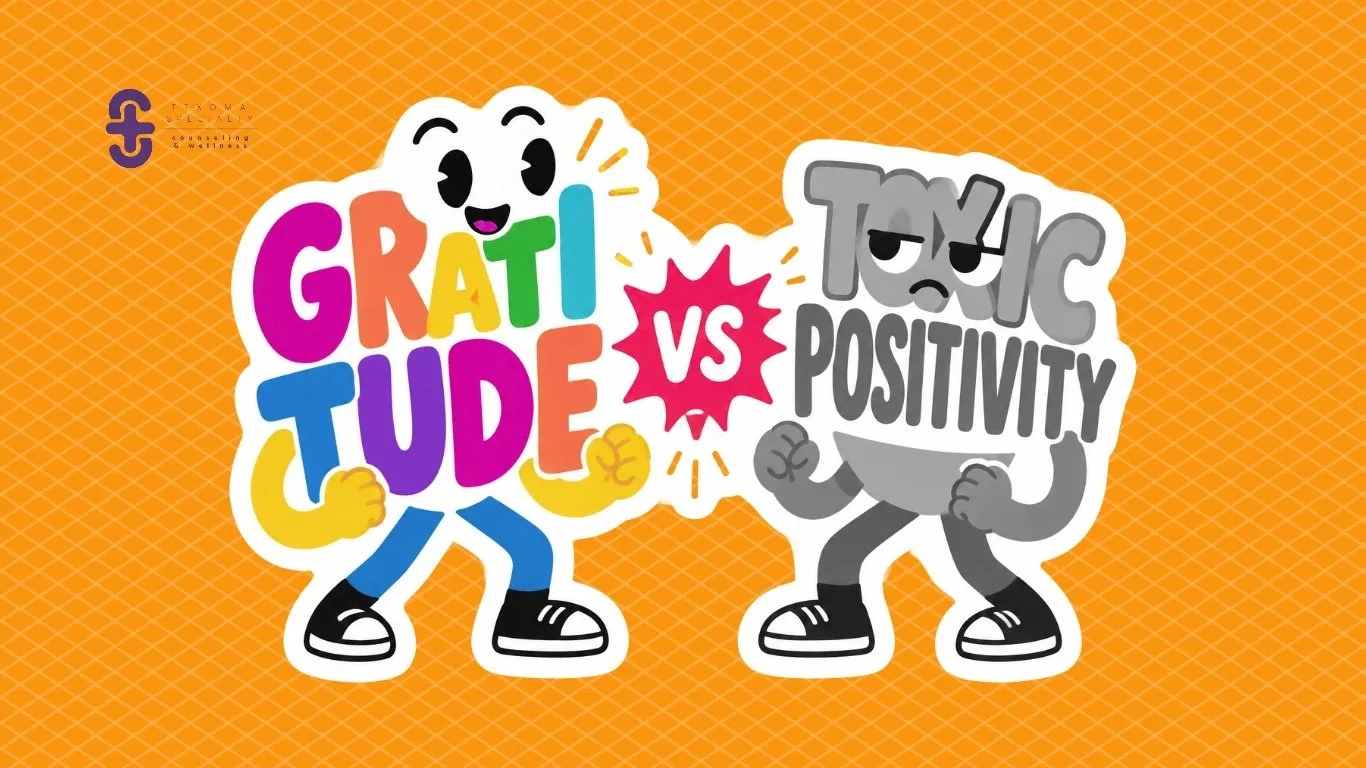
November arrives and suddenly everyone is talking about gratitude. Gratitude journals. Gratitude challenges. "Just focus on the good things." And honestly? Gratitude is genuinely powerful — there's solid research behind it. But there's a version of gratitude practice that gets used in a way that's more harmful than helpful, and I think we need to talk about it before we spend the whole month pretending everything is fine.
That version is called toxic positivity. And it's sneaky.
🎭 What toxic positivity actually is
Toxic positivity is the insistence that people maintain a positive mindset regardless of what they're actually going through. It sounds like:
"Just be grateful for what you have."
"Other people have it so much worse."
"Everything happens for a reason."
"Good vibes only."
"At least..."
The problem isn't positivity itself. The problem is using positivity as a lid — something to press down over painful feelings so they don't have to be seen, processed, or sat with. And when you do that, you don't actually get rid of the feelings. You just cut yourself off from them. And cut yourself off from the people around you who might be holding the same lid down even tighter. (We've written before about what to do when thinking positive doesn't work.)
⚠️ Why gratitude gets weaponized
Real gratitude doesn't ask you to pretend you're not hurting. But a lot of people use gratitude practice as a way to bypass hard emotions — because sitting with grief, frustration, disappointment, or fear is uncomfortable. It feels safer to flip to what's good.
This is especially common during the holidays, when there's enormous cultural pressure to feel happy and thankful and connected. If you're grieving a loss, estranged from family, struggling financially, or just exhausted — and everyone around you is performing joy — that pressure can feel suffocating. And then the gratitude content starts rolling in and it feels less like an invitation and more like an accusation.
🙏 What real gratitude practice looks like
Genuine gratitude doesn't skip over the hard stuff. It exists alongside it. Research from positive psychology consistently shows that gratitude is most powerful not when it denies negative experience, but when it's practiced in full acknowledgment of it.
That might look like:
"This has been a really hard year. And I'm also genuinely grateful for the people who showed up."
"I'm exhausted and grieving and also I noticed something beautiful today and I want to hold onto that."
"Things are not okay right now. And there are still small things that feel like grace."
That's the both/and of real gratitude. Not either/or. Not "focus on the good" — but "the good exists even here, alongside the hard."
📝 Three gratitude practices worth trying this November
1. The honest gratitude journal. Instead of just listing what you're thankful for, write what's hard first. Name it clearly. Then ask: even here, even in this, is there anything I can genuinely acknowledge? This isn't about forcing it. Some days the answer is small. That's okay.
2. Gratitude toward yourself. We rarely include ourselves in gratitude practice. This month try acknowledging something you did that was hard, something you survived, something you kept showing up for even when you didn't want to. You're allowed to be on your own gratitude list.
3. Express it outward. Research shows that expressing gratitude to another person — not just writing it privately — has a significant impact on wellbeing and relationship satisfaction. Text someone. Tell them. Make it specific. Not "thanks for everything" but "I've been thinking about when you did this specific thing and it mattered."
🍂 A note for the hard Novembers
If this is a hard November for you — if you're grieving, or lonely, or dreading the holidays, or just running on empty — you don't have to perform gratitude to belong in this month. You are allowed to have complicated feelings about a season that tells you to feel one thing.
And if those feelings are bigger than you can carry alone, that's what we're here for.
Learn more about our anxiety & depression therapy, or book a session today. We're in network with Aetna, BCBS PPO, Cigna and UHC/Optum — see fees & insurance for details, or call (888) 659-7618.
— Dr. Steph