
The word "trauma" gets used a lot these days. And honestly? I think that's mostly a good thing. The more we talk about it openly, the less shame people carry about their own experiences. But with that increased conversation comes some real confusion about what trauma actually is — and who it applies to.
So let's clear it up.
⚖️ Trauma is not a competition
One of the most harmful things I see in my work is people dismissing their own pain because they don't think their experience was "bad enough" to count as trauma. They compare themselves to someone else's story and decide theirs doesn't qualify. So they don't seek help. They white-knuckle it. And the unprocessed stuff just keeps living in their body, shaping their relationships and their nervous system responses, whether they name it trauma or not.
Trauma doesn't care about your ranking system. It cares about what happened to your nervous system.
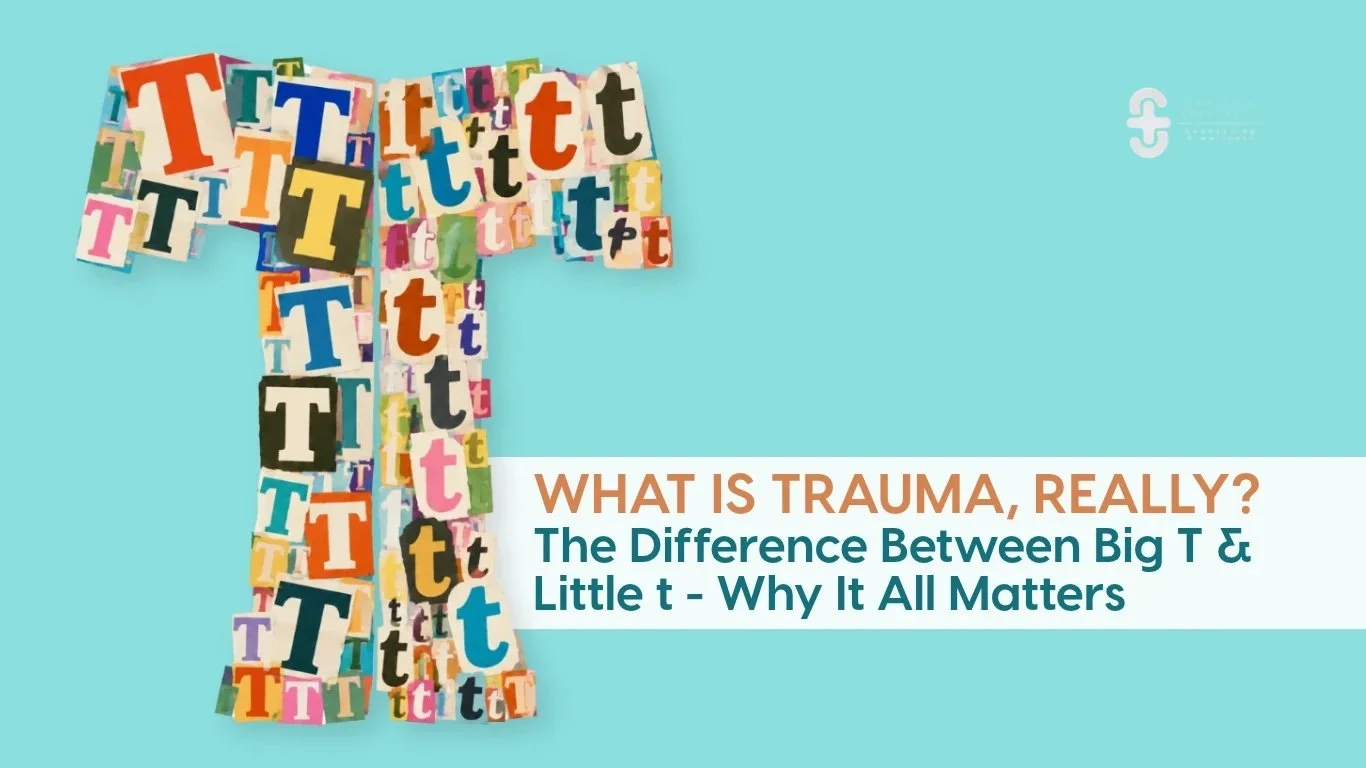
⚡ Big T trauma
Big T traumas are the events most people think of when they hear the word. They're the ones that are obviously overwhelming — the kind that would shake almost anyone.
Surviving or witnessing violence or abuse
Sexual assault
A serious accident or life-threatening medical event
The sudden loss of someone you love
Natural disasters
Combat or war exposure
Childhood neglect or severe abuse
These events are significant, acute, and often meet the clinical criteria for PTSD. They tend to be easier to identify — both the person and the people around them can usually point to the event and say "that was the thing."
💧 Little t trauma
Little t traumas are subtler, more chronic, and in some ways more insidious — because they're easier to dismiss. They're the experiences that were painful and overwhelming for your particular nervous system, even if they don't fit the dramatic definition of trauma.
Emotional neglect — being physically present but emotionally invisible to your parents
Chronic criticism or shame in childhood
Bullying, social rejection, or not fitting in
A difficult divorce — yours or your parents'
Ongoing relationship conflict or betrayal
Repeatedly being dismissed, minimized, or not believed
Growing up in a household with addiction, mental illness, or unpredictability (what researchers call adverse childhood experiences)
Microaggressions and the cumulative burden of discrimination
Feeling chronically unsafe, unlovable, or like a burden
Little t traumas often don't have a single identifiable moment. They're more like water damage — slow, accumulating, invisible until something starts to crack. And because they're not dramatic, people often carry them for decades without ever connecting them to the anxiety, the relationship patterns, the self-worth struggles they're experiencing today.
🧠 The thing both have in common
Whether it's a Big T or a little t, trauma is what happens when an experience exceeds your nervous system's capacity to process it. The event gets stored incompletely — fragments of sensation, emotion, belief, and body memory that didn't get fully digested. And those fragments keep getting activated, often without the person even knowing why.
That's why trauma shows up the way it does — not usually as a clear memory of the event, but as a feeling that comes out of nowhere, a reaction that seems disproportionate, a pattern you can't stop repeating, a belief about yourself that no amount of logic seems to shift.
🛠️ How we treat trauma at TSC
We take a holistic approach to trauma & EMDR therapy in Sherman, TX — which means we don't just rely on one tool. Depending on where you are and what you need, treatment might include:
EMDR (Eye Movement Desensitization and Reprocessing): One of the most well-researched trauma treatments available. It helps the brain reprocess stored traumatic memories so they lose their emotional charge. You still remember what happened — it just stops running the show. Jaclyn Contreras is EMDR-certified at TSC, and several other team members are EMDR-trained.
KAP (Ketamine-Assisted Psychotherapy): For trauma that's been deeply resistant to other approaches, KAP creates a window of neuroplasticity — a temporary state where the brain is more open to new patterns and processing. Dr. Steph offers KAP at TSC.
Trauma-Focused CBT (TF-CBT): A structured, evidence-based approach particularly effective for children and adolescents who have experienced trauma. It works with both the young person and their caregivers.
IFS (Internal Family Systems): A powerful framework for understanding the different "parts" of ourselves — including the parts that developed to protect us from painful experiences. IFS is deeply compassionate and often creates profound shifts in how people relate to their own inner world.
Trauma-Informed Therapy: The foundation of everything we do at TSC. Every clinician on our team approaches their work through a trauma-informed lens — which means safety, trust, and pacing are built into every session, regardless of your diagnosis or history. (More on that in Trauma-Informed Care Isn't Just for People with PTSD.)
Trauma-Informed Wellness: Healing doesn't only happen in the therapy room. Our yoga and sound bath classes with Teri Carlo are designed to support nervous system regulation as part of a whole-person healing approach. The body holds trauma, and the body is part of how we heal it.
🌱 The hope I want to leave you with
Your brain and nervous system have the capacity to heal. I've watched it happen over and over again. People who were convinced they'd always feel this way — anxious, reactive, disconnected, stuck — who found their way to something different.
It takes time. It takes the right support. And it starts with deciding that what you experienced matters enough to address, regardless of how it compares to someone else's story.
It matters. You matter. And there is a way through.
When you're ready, meet our counselors, explore trauma & EMDR therapy or KAP at TSC, or book a session. We're in network with Aetna, BCBS PPO, Cigna and UHC/Optum — see fees & insurance for details, or call (888) 659-7618.
If you're in crisis, call or text 988 (Suicide & Crisis Lifeline) or call 911.