
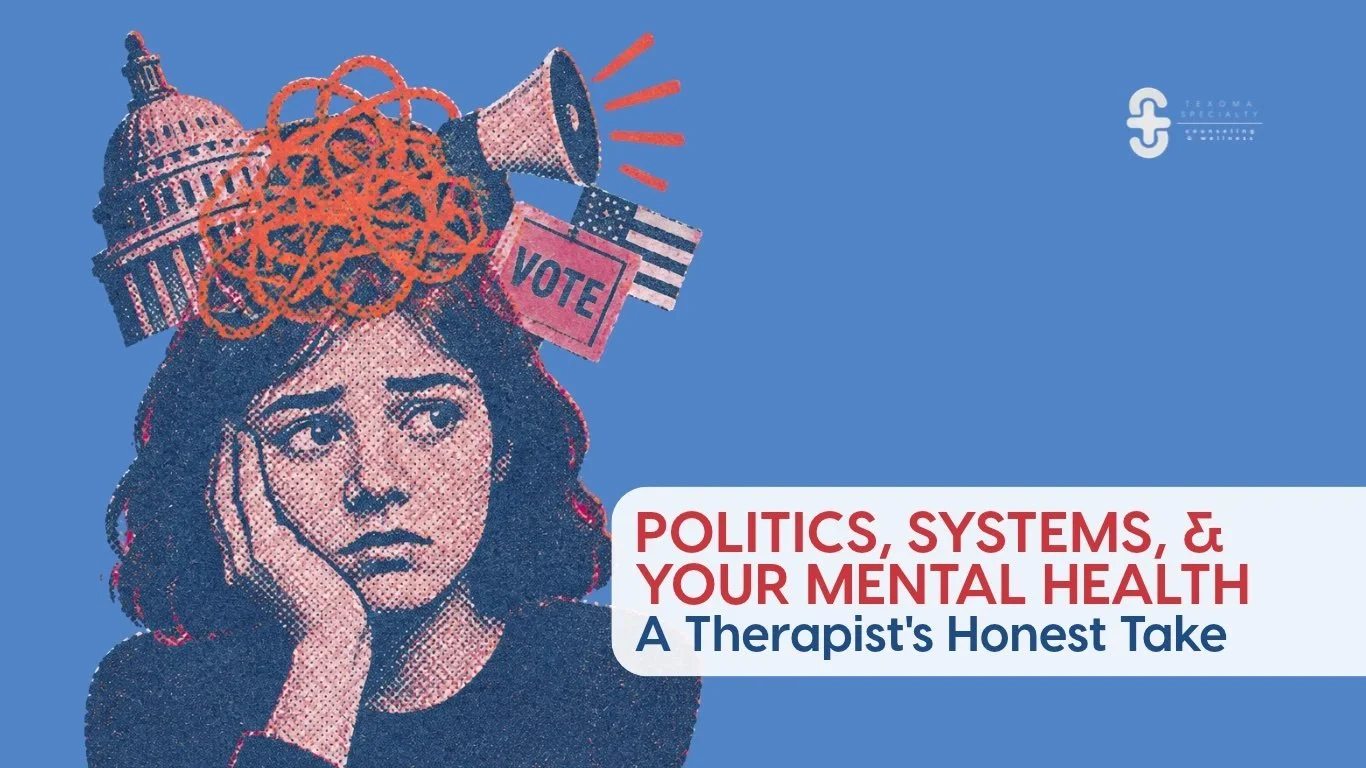
I want to start with something important: this is not a political post. I'm not going to tell you who to vote for, which party to support, or what policies to back. That is genuinely none of my business — and more than that, it's not my place. My job is to hold space for every person who sits across from me, regardless of where they land politically. My clients know I'm a human with opinions, but those opinions have never been and will never be part of treatment. That's not how good therapy works.
What I am going to talk about is this: political systems have a real, measurable impact on mental health. And as a systems-trained therapist, ignoring that would be its own kind of dishonesty.
🧭 What it means to think systemically
Systems therapy starts from the premise that people don't exist in a vacuum. We are shaped by the systems around us — our families, our communities, our cultures, our institutions. When those systems are healthy and supportive, people tend to do better. When they're broken, harmful, or inaccessible, the people inside them carry that weight.
Political systems are no different. The policies that get made — or don't get made — about healthcare, housing, education, income, and yes, mental health funding, directly affect whether people can access care, afford care, and feel safe enough to seek it. That's not a political statement. It's a clinical reality.
🛋️ How politics shows up in the therapy room
I see it constantly. Clients who can't access therapy because their insurance won't cover it — or won't cover enough of it. People in marginalized communities who don't seek help because historically, systems that were supposed to help them have harmed them instead. Clients whose anxiety spikes around election season not because of one candidate or another, but because the uncertainty of it all — the sense that the ground might shift under their feet — activates a nervous system that was already on high alert.
I see people who feel powerless. Who feel like nothing they do matters. Who have disengaged from civic life not out of apathy but out of exhaustion and learned helplessness — a very real psychological response to feeling like your actions have no impact.
And I see people on every side of the political spectrum carrying real distress. Anxiety about the future. Grief about what they feel they've lost. Fear about what might change. The political climate — again, regardless of which side you're on — is genuinely stressful. In the American Psychological Association's 2024 Stress in America survey, 69% of adults named the presidential election as a significant source of stress. That stress is real and it deserves to be named.
🏛️ Why, historically, systems have caused harm
Part of my training as a systems therapist means I can't look away from the fact that many of the systems we've built — mental health systems included — have not served everyone equally. Certain communities have been pathologized, over-medicated, under-served, or actively harmed by institutions that were supposed to help. That history matters. It explains why trust in systems is low in certain communities. It explains barriers to care that go far beyond cost or geography. And it means that if we want a mental health system that actually works for everyone, it requires ongoing, honest examination of how those systems have functioned and for whom. (I wrote more about this in Mental Health Is Political — And That's Not a Partisan Statement.)
🗳️ What you can actually do
Here's where I land — and this is the part I feel pretty strongly about, clinical hat and all: if there is something you care about, take it to the polls.
Mental health funding. Healthcare access. Policies that affect the communities your people belong to. Whatever it is that you lie awake thinking about — there is almost certainly a ballot somewhere that touches it. Early voting in Texas is open right now. You don't have to wait until Election Day. You don't have to spend hours researching every race. You just have to show up for the things that matter to you.
Voting is one of the few places where a person who feels powerless gets to do something concrete. And in a world that can make people feel very small, that matters more than I can say.
💬 One more thing
If the political climate has been genuinely affecting your mental health — your sleep, your anxiety, your relationships, your ability to be present — that is a real thing worth talking about in therapy. It doesn't matter where you are politically. Stress is stress. Anxiety is anxiety. And you deserve support for all of it.
TSC is a space where your political beliefs are yours. I'm here to help you process what you're carrying, not to add to it.
Take care of yourselves out there. And go vote. 🗳️
If stress is spilling into your sleep or your relationships, learn more about our anxiety & depression therapy or book a session today. We're in network with Aetna, BCBS PPO, Cigna and UHC/Optum — see fees & insurance for details, or call (888) 659-7618.
— Dr. Steph