

Back to School, Back to Overwhelm: Helping Your ADHD Kid (& You) Survive the Transition
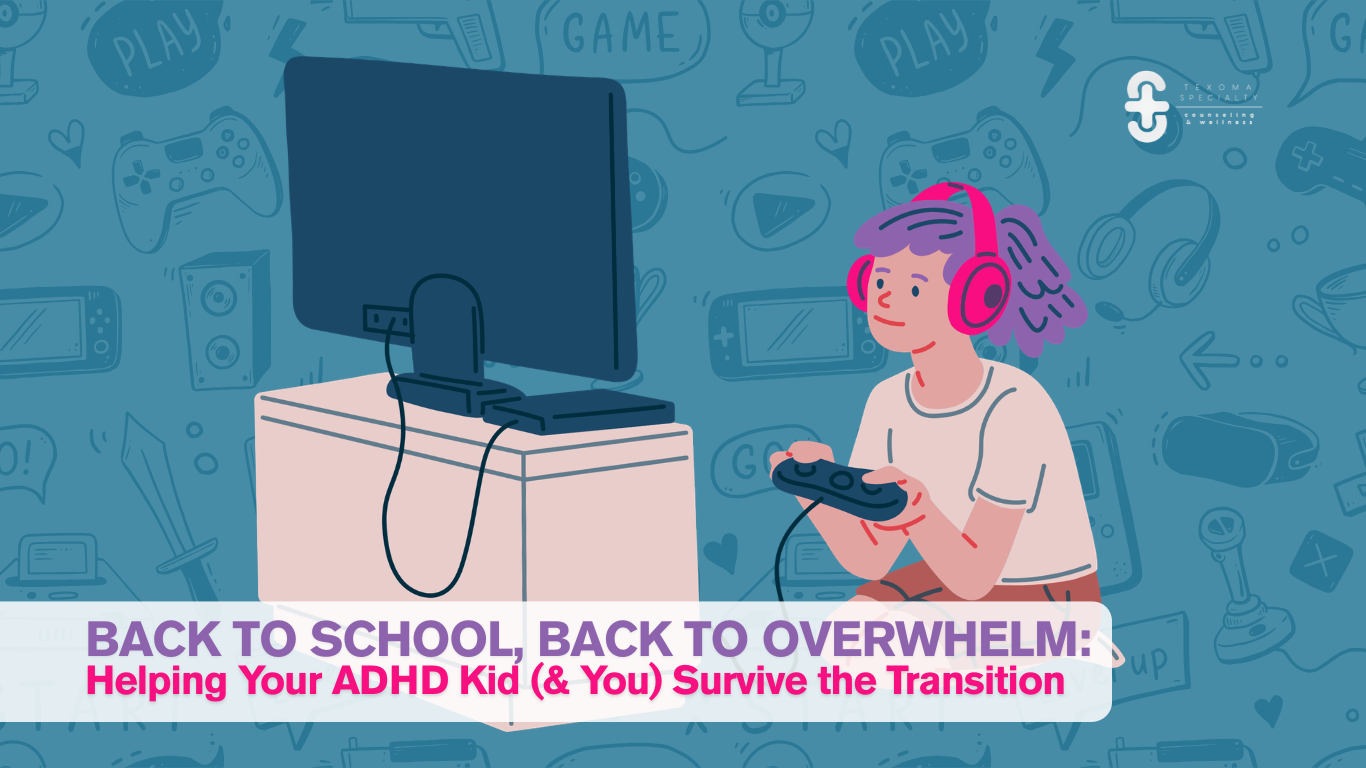
🎮 ADHD, Back to School, and Why Your Kid's Meltdown Over the Backpack Makes Total Sense
Hi, I'm Elizabeth — I'm the newest counselor at TSC, and I work with kids, teens, and adults using play therapy, sand tray, and yes, video games. If your kid is the one who can build an entire Minecraft world from memory but can't remember to bring their backpack home, you might be exactly who I'm talking to.
August means one thing for a lot of families in Texoma: the slow, dreaded countdown to the first day of school. For neurotypical kids, that transition is hard enough. For kids with ADHD, it can feel like someone hit fast-forward on their whole nervous system with zero warning.
🧠 Why "back to school" hits ADHD brains differently
ADHD isn't about effort or attention span in the way people assume — it's about regulation. Regulation of time, of emotions, of impulses, of energy. Summer, for all its chaos, usually comes with more flexibility: looser schedules, fewer transitions, more room to self-direct. School flips that completely. Bells, seating charts, multi-step instructions, sitting still, switching subjects every fifty minutes — it's a lot of executive function demand stacked on a brain that's already working overtime just to keep up.
💬 So when your kid melts down over picking out a backpack, or suddenly "forgets" how to do basic morning routines they had down in May, that's not defiance. That's a nervous system bracing for impact.
🪄 What Actually Happens in Sessions with Me?
This is where the toys and the games come in, and I promise it's not just because I think Pokémon cards are cool (although, I do). Play and video games give kids a way to process big feelings — anxiety, dread, frustration — without needing the words for it yet, which a lot of kids genuinely don't have.
In sand tray work:
A kid can build a "school world" with tiny figures and show me, without saying a single sentence, what feels overwhelming or scary about it.
In video game–assisted sessions:
We might work through frustration tolerance in real time — what does it feel like in your body when you lose a level, and what do you do with that feeling? Those are the exact same skills they need when a teacher corrects them in front of the class or a group project goes sideways.
✅ A few things parents can try at home right now
👁️ Visual schedules beat verbal reminders, every time.
ADHD brains are often stronger with "what I can see" than "what I was told."
🔁 Practice the routine before it's real.
Walk through the morning sequence — alarm, clothes, breakfast, backpack — a week or two before school starts, with zero pressure attached.
🛋️ Build in a decompression buffer after school.
The "performance" of holding it together all day often comes out the second they're home. That's not a behavior problem, that's relief.
🗣️Name it out loud.
Something as simple as "transitions are hard for your brain, and that makes total sense" can take a layer of shame off a kid who already feels like they're failing at something other kids do easily.
🌿 You don't have to figure this out alone
If your child is dreading the school year, or you're already exhausted just thinking about the mornings ahead, I'd love to help. I have a few openings right now for kids, teens, and families looking for support heading into the fall. We can use play, sand tray, or even the games they already love to build the skills that make this transition feel a little less like free-fall.
📅 Connect with Elizabeth
👉 Learn more about Elizabeth
📞 Call TSC at (888) 659-7618
🌐 texomaspecialtycounseling.com
📚 Further Reading & Sources
Why Play Therapy Works — Association for Play Therapy — The professional and research foundation for play therapy, including why non-verbal, play-based approaches are often more effective than talk therapy for children.