
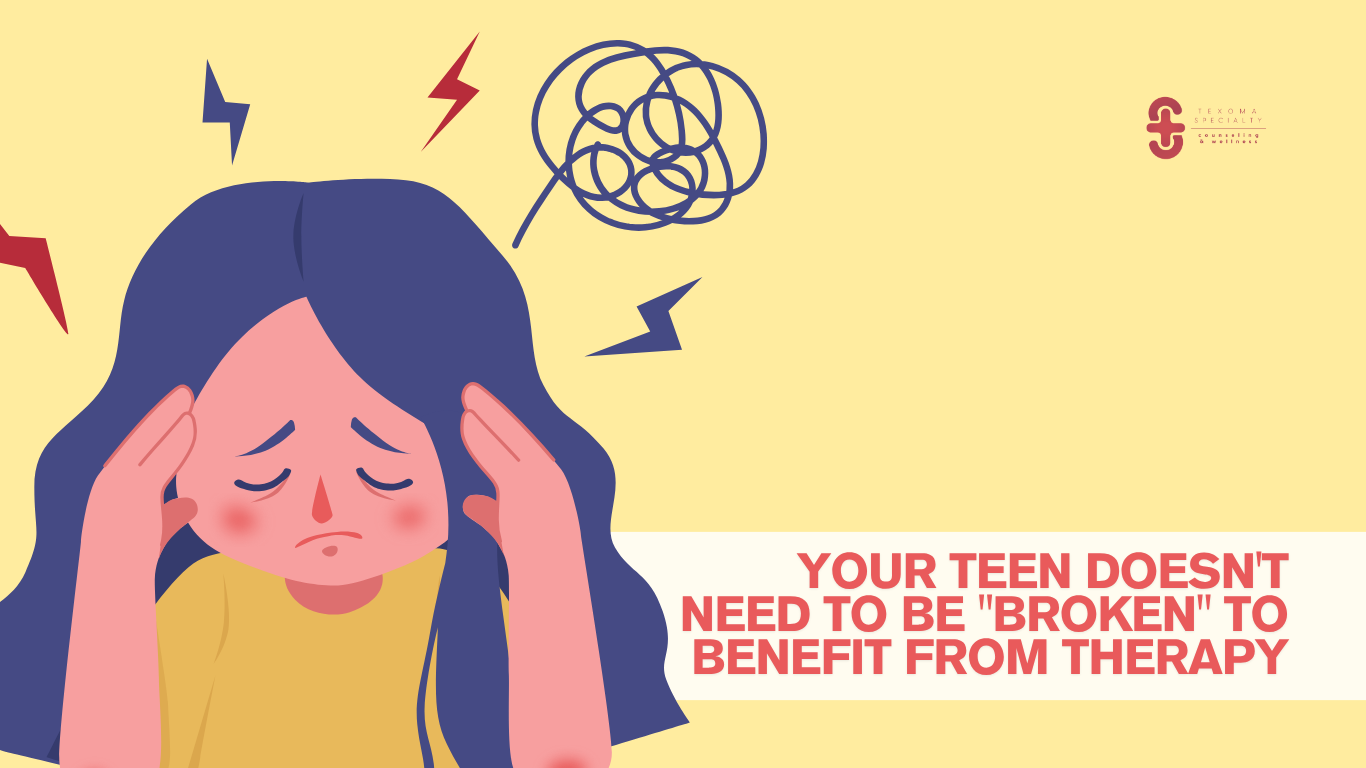
Your Teen Doesn't Need to Be "Broken" to Benefit From Therapy
🌱 Therapy Isn't Just for Teens in Crisis — It's a Life Skill
Hi, I'm Danielle — I work primarily with kids and teens here at TSC using play therapy and sand tray, and if there's one myth I wish I could retire forever, it's this one: therapy is only for teens who are "in crisis."
By the time school's been back in session a few weeks, I always see the same pattern. Parents reach out once things have already boiled over — a meltdown, a failed test, a friendship blowup, a slammed door. And I get it, because that's usually when the discomfort finally outweighs the hesitation. But I want to make a case for something different this year: therapy before the breaking point, not just after it.
💡Therapy isn't a last resort — it's a life skill
We don't wait until someone's body completely breaks down to take them to a doctor. We do checkups. We catch things early. Mental health deserves the same logic, especially for teens, whose brains are still actively developing the exact skills therapy strengthens: emotional regulation, identity formation, decision-making, and relationship navigation.
A teen who starts therapy now — not because something's "wrong," but because they're human and growing through a genuinely hard developmental stage — is building tools they'll use for the rest of their life. That's not crisis intervention. That's prevention.
🎨 What therapy with teens actually looks like
This isn't always a teen sitting across from me answering "so how does that make you feel?" Real talk: most teens would rather do almost anything else than that. With kids and teens, I lean heavily on play therapy, sand tray, and creative expression, because these tools meet teens where they actually are — they let big, hard-to-name feelings come out sideways, through metaphor and imagery, instead of requiring a teen to have the emotional vocabulary adults take for granted.
That's often where the real breakthroughs happen. Not because I asked the perfect question, but because a kid built something in the sand tray that told me everything they couldn't say out loud.
✅ The benefits I see most often
🗣️ Better communication at home, because they're practicing naming feelings in a low-stakes space first.
🛠️ Stronger coping skills for the everyday stuff — friend drama, academic pressure, family stress — before it snowballs.
🤝 A real, trusted adult relationship outside the family system — which matters enormously during a developmental stage built around individuation.
🔍 Earlier identification of bigger concerns — anxiety, depression, disordered eating, self-harm — while they're still small and highly treatable.
💜 A note to parents who feel like they're "overreacting"
You're not. Wanting support for your teen before things get hard is not overprotective parenting — it's good parenting. Therapy doesn't have to mean something is wrong. It can simply mean you want your kid to have somewhere steady to land while they figure out who they're becoming.
📅 Let's talk
If you've been on the fence about getting your teen connected to support — whether something specific is going on or you just want them to have that space — I'd love to help. I have openings now, and I promise, it doesn't have to start with a crisis.
Whether something specific is going on or you simply want your teen to have a supported space heading into the school year — this is a good time to start.
👉 Learn more about Danielle
📞 Call TSC at (888) 659-7618
🌐 texomaspecialtycounseling.com
It doesn't have to start with a crisis. 🌱
📚 Further Reading & Sources
The Teen Brain: 7 Things to Know — NIMH — National Institute of Mental Health overview of adolescent brain development and why the teen years are both a vulnerable and uniquely opportune window for building mental health skills.
Why Play Therapy Works — Association for Play Therapy — The professional evidence base for play therapy, including its applications with older children and adolescents who benefit from non-verbal, metaphor-based processing.